Hey, there, folks! As you might have noticed, You Bitch! got a new coat of paint. I've been cobbling together a new blogging system in my spare time, using Python and the Django web development framework. If you like, you can see a few technical details over on the Impressum.
It's not quite finished, but it can already do several things that I was hoping for:
Full metaWeblog, Movable Type, and Blogger APIs implemented, for use in desktop blogging clients like Ecto
Gallery2's Gallery Remote protocol1, for uploading image galleries out of iPhoto or another program with a Gallery2 plugin
Podcasting stuff, which you may have noticed doesn't work
Some online services, like to-do list and calendar, for internal use
Monthly newsstand-style editions in PDF format, mainly for a lark
This is my second big Django project. The first project was an online software activation and license management server for a customer of mine. Even though I don't really know much about programming, I was able to pack actual functionality in to a few hundred lines of code. I'll probably put the source up, as soon as I've taken the cuss words out of it.
I'm amazed again and again at how easy Python makes it for a talentless hack like me to make things that don't suck.
Gallery 2 has to have the Worst API documentation ever ↩
I'm still not sure how that goes with the pingbacks though. That might not even be possible. ↩
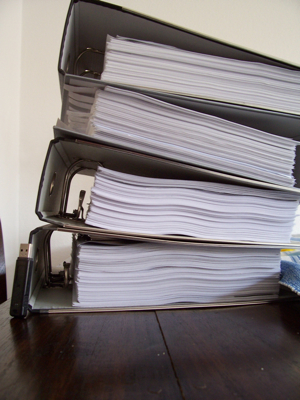
A female friend of mine, who shall remain anonymous, is busy at the moment taking the final exams for her master's degree. For the past two weeks, she's been running to the university and back, making copies of her study materials at about 5 cents per page. Check out the pile of tree pelts that's accumulated on my beloved colonial dining table:
There are probably hundreds of students over at the university right now who are doing the exact same thing. All told, that's about 5000 pages, at a cost of over $100 in processing and copying fees, for each student taking the exams. Now, I wouldn't presume to tell an institution of higher learning that they're full of shit, but I can't help think that it might have been a better use of their resources to distribute electronic versions of these materials. I mean, as long as they're letting people copy them, why not try to keep the rainforest from getting chopped and cleared at the same time? Note the USB stick at the bottom left of that picture, which would hold 200 times as much information as the stack of folders it's leaning on.
For purely scientific purposes, I combed a few BitTorrent sites to see if any of the textbooks my anonymous girlie was copying were available in E-Book format. Almost all of them were.
Everybody from Elisson to Michael Heilemann is memeing this list of 50 science fiction and fantasy books. Not being above using other people's ideas as my own, I'll be posting it as well. I'll spare the 50 lines, and just leave in the ones that I've actually read.
1. The Lord of the Rings, J.R.R. Tolkien
2. The Foundation Trilogy, Isaac Asimov
3. Dune, Frank Herbert
4. Stranger in a Strange Land, Robert A. Heinlein
6. Neuromancer, William Gibson
7. Childhood's End, Arthur C. Clarke
8. Do Androids Dream of Electric Sheep?, Philip K. Dick
9. The Mists of Avalon, Marion Zimmer Bradley
10. Fahrenheit 451, Ray Bradbury
21. Dragonflight, Anne McCaffrey
23. The First Chronicles of Thomas Covenant the Unbeliever, Stephen R. Donaldson
24. The Forever War, Joe Haldeman
27. The Hitchhiker's Guide to the Galaxy, Douglas Adams
29. Interview with the Vampire, Anne Rice
37. On the Beach, Nevil Shute
38. Rendezvous with Rama, Arthur C. Clarke
41. The Silmarillion, J.R.R. Tolkien
42. Slaughterhouse-5, Kurt Vonnegut
46. Starship Troopers, Robert A. Heinlein
48. The Sword of Shannara, Terry Brooks
I like lists like these, but I think this one's misnamed. Tolkien's books, for example, are not within the 50-year time span any more (the original list is from 2002), and shouldn't be there. And although I'm sure they're all good, I don't know if I'd consider some of them all that influential. Electric Sheep, for example, is nowhere near as good or influential as Dick's paranoium opus Vulcan's Hammer. The only reason anybody still knows about it is because of Blade Runner's hat tip.
Some I'd add to the list:
Andromeda Strain and Jurassic Park by Michael Crichton, both of whose successes inspired, in their times, a return to 'hard' science fiction (although its science wasn't quite as hard as Crichton made it out to be).
Dungeons and Dragons first edition by Gary Gygax, as long as being a 'novel' isn't a prerequisite–I mean, how many people derived works from that? It completely redefined the way people thought about the fantasy genre. And bathing.
The Moon is a Harsh Mistress by Robert Heinlein. It's still Heinlein's best book, in my estimation, and hey, it gave us TANSTAAFL. Better than Starship Troopers, which is probably fightin' words with a lot of people, and number two on my Why the Hell Ain't They Made it a Movie list, right after Satanic Verses.
Sirens of Titan, by Kurt Vonnegut. My favorite Vonnegut book; it's basically the same as Slaughterhouse-5, just a bit more screwy. I think it's a pretty good bet that drugs played a wee part in the making of this one.
Tarnsman of Gor by John Norman. Although ripped root and branch right out of Edgar Rice Burroughs' ass, this book had more sequels than most of the other books on this list had imitators.
Some I'd remove from the list:
The Forever War by Joe Haldeman. I like this book; I've read it at least a dozen times; but it's kind of cheesy. And I think you'd be hard pressed to say that it had a lot of influence in the sci-fi/fantasy world. There's about a million books out there that left a bigger crater than this one.
Do Androids Dream of Electric Sheep? by Philip K. Dick. I'll give them The Man in the High Castle, but Electric Sheep is crap, and all that Mercerism mumbo-jumbo can kiss my ass. Sounds like somebody thinks it's still hip to over-represent Philip K. Dick. His stuff wasn't bad, but give it a rest already.
Sword of Shannara by Terry Brooks. I remember reading the Shannarah books as a fat, lonely teenager. Even then, it seemed derivative.
Software Update for 10.4.9 happened to me today while I was busy making other plans. Usually, I trust Steve implicitly, and consider him my spiritual guide and cult leader. Today, out of pure chance, I actually looked at the update:
The 10.4.9 Update is recommended for PowerPC and Intel-based Mac computers currently running Mac OS X Tiger version 10.4.8 and includes general operating system fixes, as well as specific fixes or compatibility updates for the following applications and technologies:
RAW camera support
Handling of large or malformed images that could cause crashes
Image capture performance
Mouse scrolling and keyboard shortcuts
Font handling
Playback quality, and bookmarks in DVD Player
USB video conferencing cameras for use with iChat
Bluetooth devices
Browsing AFP servers
Apple USB Modem
Windows-created digital certificates
Open and Print dialogs in applications that use Rosetta on Intel-based Macs
Time zone and daylight saving for 2006 and 2007
Security updates
Doesn't that sound entertaining. I'll have to check that out, at the expense of my three-week uptime.
Libertarians, and especially the likes of Neal Boortz, like to short-circuit arguments relying on the tenets of democracy as irrelevant in American politics. The reasoning behind this, according to Boortz, is that the United States is not a democracy, seeing as democracy implies the rule of the majority at the expense of the minority rights. This has become a popular meme among Libertarians and Individualist Anarchists alike. According to Boortz' own take on President Bush's State of the Union address in January:
Democracy: Four references to democracy. In one passage he referred to the United States as "a great democracy." Our founding fathers warned us against the establishment of a democracy They were very clear in their fear of democracy. Historians of that era loudly warned against the creation of a democracy after the Revolutionary War ... but here we are in 2007 listening to the President of the United States referring to us as "a great democracy." I know that, thanks to government education, not one one hundred people in this country have a clue why our founding fathers abhorred the idea of democracy ... and that is no accident.
This is obviously more of a pet peeve than an intellectual argument, and it's typical among those who define democracy strictly as "majority rule". Many Libertarian and anarchist sites, for example, harp on an old U.S. Army document that supposedly listed democratic governments among the enemies of liberty and freedom, describing them as "a government of the masses". I say 'supposedly' because I've yet to see a citation to an official source of this document, but we'll assume for the sake of argument that somebody, at some point in time, actually saw a copy of this document, and the information has been preserved through its numerous retellings. Not to mention the fact that the Army withdrew that document, and in my opinion never should have released such a thing in the first place. The Army should not be in the business of defining American political philosophy, any more than policemen should write the laws they enforce.
This definition of democracy as "a government of the masses" is a redefinition of a) the prefix demo-/dema- to mean 'masses', as in demagoguery or demography, when it actually means "the people"; b) the people as "the masses", which is a rhetorical trick to negatively transform constituencies into monolithic systems; and c) government into law. The problem with using old texts as scripture, especially ones that have been retracted, is that they eventually become anachronistic in their language, their symbols, or both. The fact is that democracy, as a system of government, is not defined as "majority rule" any more, if indeed it ever was. For example, the current Oxford Dictionary1 defines democracy thusly:
democracy |di?mäkr?s?| noun ( pl. -cies)
a system of government by the whole population or all the eligible members of a state, typically through elected representatives : capitalism and democracy are ascendant in the third world.
a state governed in such a way : a multiparty democracy
control of an organization or group by the majority of its members : the intended extension of industrial democracy.
the practice or principles of social equality : demands for greater democracy
America fits snugly into the first definition. By most modern definitions of the word, democracy covers systems such as republics, representative republics, and the bizarre, three-tiered social oligarchy that exists over here in Germany, and also in most Western European governments, in conjunction with the hinky, dysconstitutional spectre of the European Union. As much as I enjoy listening to Neal, his argumentativeness over the word democracy as meaning "mob rule" is intellectually dishonest, because it redefines the agreed terms of discussion in the middle of the debate. He will also slip up every now and then, describing the goal of the Iraq War as the building of a democracy in Iraq, which is supposedly the last thing we'd want to see happen. It reeks of desperation and defeat, distracting as it is from the real point of Libertarianism, that the protection of individual rights and freedoms should be the major role and purpose of government. And that is an argument that doesn't need to hide itself behind pedantic word-play.
As of OS X 10.4.9, which includes the Oxford English Dictionary. ↩
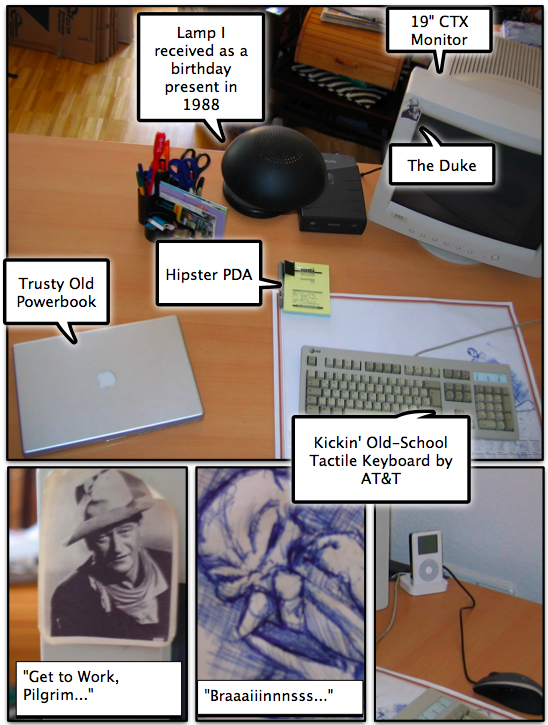
Since I finally cleaned up my desk, in my preparations for the selling thereof, I get to see what it actually looks like. Once you get the old coffee cups, whiskey bottles, condom wrappers, and used hypodermic needles off, it closely resembles a healthy, productive environment. So let's see what's on Rube's desk!
Dax is a Linux guy now? Good luck, man, I'll be right there with you in a couple of weeks, at least at the office. But at home? I'd rather take a poke in the eye with a sharp stick than run Linux as my day-in, day-out desktop. But the price is right, and the licensing terms are more than agreeable, so if you have the time, and hate playing MP3s and games, Linux might just be for you. Naturally, my first instinct as a smug Apple Fanboi is to rip out my hair and say, "DAX, MAN, WHY YOU HATE YOU'RE FAMILY GET A MAC! OMG!". But he knows about Macs, and still decided on Linux. His reasoning, however, piques my interest:
Not that I’m going to become one of those freaky Apple people, mind you. After all, I like to actually run more than a handful of programs. However, I have downloaded Red Hat Linux. Let the learning begin!
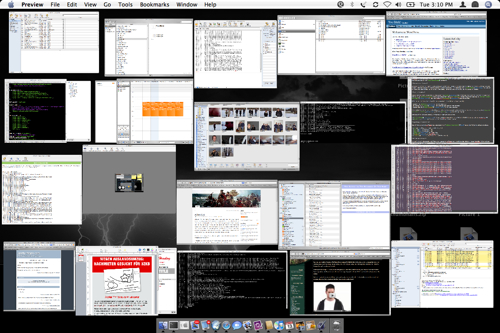
"Handful of programs," I thought to myself, and hit the F9 key on my keyboard, bringing up Exposé:
Doing! That's gotta be like, 500 windows there. Has that crap really been running in the background all this time? I need to close a program every now and then, methinks. I know that document window in the bottom left, with the red header, has been open at least a week. That's when we printed the flyers for our apartment. It gets away from you sometimes, that desktop management thingy.
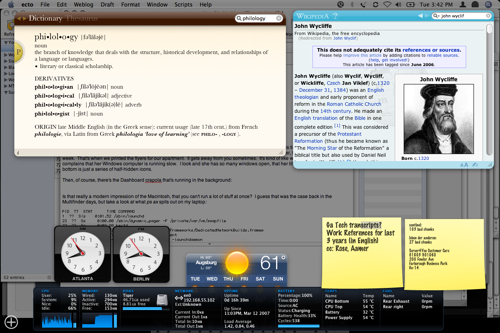
Then, of course, there's all that Dashboard crapola that's running in the background:
Is that really a modern impression of the Macintosh, that you can't run a lot of stuff at once? I guess that was the case back in the Multifinder days, but take a look at what ps ax spits out on my laptop:
[75 lines of meaningless code deleted]
I would say that's more than a handful. Or maybe Dax is talking about program availability. Like the ability to walk into a store and pick out shrink-wrapped software to take home with him. That would make sense, seeing as the acceptance of the Macintosh doesn't compare at all with that of Windows, especially in the retail space. But then, he's switching to Linux. If he thinks he's going to find software for Linux at Best Buy, well.... BWWWAAAAHAHHHAAAHAAAAHAAA!!! Talk about a rude surprise in the waiting.
Oddly, I just spent an hour trying to figure out why the sidebar of this blog disappears when viewed in Internet Explorer 6. There's apparently a missing tag, or a bad HTML element somewhere, or whatever it is today that causes IE6 to get the vapors.
I say 'oddly' because I really don't give a fuck how any of my pages look in IE. If you're still using Microsoft's abortion of a browser after all suffering and human misery that it's caused, you are a traitor and a Communist. Which is unfortunate, because look what you assholes are using?
Browsers
Unique Visitors
MSIE 6
88229
62.16%
Netscape 7
46143
32.51%
Netscape 4
3038
2.14%
MSIE 5
2873
2.02%
Other
1096
0.77%
Netscape 3
249
0.17%
MSIE 4
247
0.17%
WebTV 1
12
0.00%
Opera 6
5
0.00%
AOL 4
4
0.00%
MSIE 3
4
0.00%
Opera 5
1
0.00%
Netscape 34.82% - MSIE 64.36% - Other 0.78%
I mean, what's up with you dickheads, anyway? This table tells me that at least 64.36% of my visitors are slobbering, knuckle-dragging waterheads. Did you ever wonder why 90% of email nowadays is spam? It's because dickheads like you surf porn sites using Internet Explorer, get viruses, and your computer uses your cable modem to send spam to people who should hate you, 24/7.
Is it really just beyond you people to go out and download Firefox? Do you really not understand that using IE is like going to prison with a naked Angelina Jolie tattooed on your back?
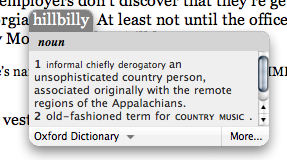
I was playing around with the Mac OS X dictionary applet today. It's that cool bit where, if you hit Control-Alt-D, you'll be given the Oxford English Dictionary definition for whatever word you happen to have the mouse cursor over at the moment. I ran it over a blog entry I wrote a few days ago, and got the following:
An "unsophisticated country person", you say? Sounds like a fairly P.C. definition of a hillbilly. I'm sure that hillbillies everywhere are pleased with the objectivity of that entry, at least the ones that own the Oxford English Dictionary. Or a Mac, for that matter, which I'm sure is the preferred computing platform for hillbillies everywhere.
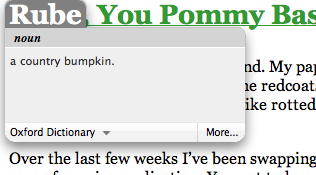
Well, let's see what they say about Rube:
What the...? Well, that seems a little dismissive to me. Do I need to point out the fact that hillbillies got a six-syllable Scrabble-buster to describe them? And really: Bumpkin? Is that even a word? Dang, dudes, at least try to temper your contempt for a second.
My optimism for a warm welcome from the British folk isn't really stoked by this. "Hello, Mr. Bumpkin, welcome to England. Please be aware that chewin' on wheat stalks is restricted to designated areas. Enjoy your stay."
It looks like I'm moving to England. My papers have gone through, so now instead of sitting around griping about the Huns, I'll be bitching about the redcoats. In about two weeks, the beer will be warm, the sausages weak and flabby, and the teeth around me like rotted tree-stumps in a putrid bog. They happen quickly, these changes in context.
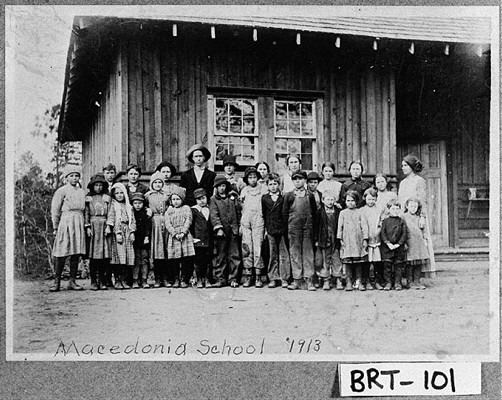
Over the last few weeks I've been swapping emails with the high-powered London lawyering firm that's taking care of my visa application. You got to know when to cover your redneck past when dealing with certain types of people. I try to keep the y'alls in the closet where they belong. And I really have to bite my tongue whenever I start to bring up all those tales about Pappy getting put on the peanut farm a short trick for moonshining. You've got to pick your audience when you're bringing out the really good stories, you know. I mean, I can't even put a picture of my family on my desk. My cover would be blown:
That's Pappy in the dark jacket, just right of center in the front row. He wore shoes because it was Picture Day. How do explain that to an scone-eatin' Englishman?
I just hope my future employers don't discover that they're getting billed $400 an hour to import some backwoods north Georgia hillbilly. At least not until the office Christmas party, when I break out the banjo and give 'em a little Foggy Mountain. Then it'll be:
RUBE: "Oh, your uncle's named Earl, too? Wow, that's interesting!"
LIMEY GUY: "No, he is an Earl. "
RUBE: "I'm outta scotch, be right back."
Playing it close to the vest; that's the new Rube.
Although I'm not much of a guitar player, every now and then I learn a tune enough to enjoy playing it. I remember commercials from my youth, hawking a crash course in learning the three or four chords on a guitar which would turn you into the envy of all your friends and the object of desire for cheerleaders and candystripers everywhere. Well, I've learned at least that many chords now, and a few songs to go with them; everything I need to be the hit of parties and campfires, as laid out by those Urban General hucksters. Unfortunately, I always seem to choose songs that a) no one wants to hear, or b) nobody can sing.
A short list of songs I can play on guitar, none of which are suitable for campfires and/or parties:
- Rowboat, by Johnny Cash. It's written by Beck, and sung by Johnny, so you can rest assured that no man born of woman can hit that first note.
- Back to the Old House, by The Smiths. Campfire + Smiths = Maudlin Loser.
- Black Gold, by Soul Asylum. It loses a bit of umph when played on creaky old acoustic guitar with plastic strings; also, no rhythm section.
- Superman, by R.E.M. Bursting into shameful tears at the line, "You don't really love that guy you make it with, now do you..." is no way to impress the ladies.
- Jane Says, by Jane's Addiction. Imagine your mom with a pint of bourbon in her, belting out "I want 'em if they waaaant meeeeee!" in her best Perry Farrel screech.
- House Above Tina's Grocery, by Kevn Kinney. "Kevn who? Play Free Bird, dumbass!"
- Norwegian Wood and/or Hide Your Love Away, by the Beatles. The last four guys who had the guitar already played it, and they were better than you anyway, so put a sock in it.
- Marie's the Name, by Elvis Presley. Although this sounds like it would work, it's important to keep one thing in mind: You are not Elvis.
So, what is a good song to learn for campfires, which requires but meagre skills? I, too, would like to be the hit of the party someday.
Since Agent Bedhead seems obsessed with this knowledge, I've decided to tell the world the complete story. I present, rather un-proudly, ashamedly, actually, The Marmoset Movie.
May God have mercy on our souls. Y'know, if there was ever a reason to learn how to put little black bars over people's eyes in iMovie, this is probably it.
People who've never been to Germany fail to realize just how bad the radio is over here. Germans are notorious cheapskates, and their penny-pinching habits extend to paying for their music. Even in well-established bars over here, you'll see stacks of clumsily-labelled CDROMs sitting next to the stereo system, or a broken down old computer playing downloaded MP3s from a Winamp playlist. That's something you hardly ever see anywhere else in Europe. In Amsterdam, for example, the bars all have a standardized, computer-based music system, displayed prouldy, that gives confidence that these are indeed Legally Purchased Tunes we're listening to. Comforting, despite the fact that they only seem to have Phish and Cold Play.
But a tiger can't change his stripes. Germans simply refuse to pony up the Euros for quality music, and nowhere is this more evident than on the radio. In contrast to the loose-cannon BitTorrent-using bar owners, the radio stations in Germany don't have the stones to play pirated music. GEMA rules the airwaves with an iron fist over here, and would swiftly visit upon such transgressions great justice. In that light, it's a perfect control group, since you can be sure that the music is legal and paid for. And when given the choice of expensive music performed by known artists or discount hootenanny doggerel fit only for a drunken choir of railway hobos, you can be sure that a German will choose the latter.
An example is in order. As I was exiting the shower this morning, I noticed a familiar melody playing from the transistor radio hanging next to the door. I stopped my vigorous towelling for a moment, and bent my ear towards the wafting notes. Something was familiar in them, yet I was convinced that it was wrong somehow. I presently recognized the tune, it being the unforgettable paean to European optimism, The Final Countdown, from the rock and roll band which, in a most rascally fit of cheekiness, decided to name itself Europe, despite the curse of naming your band after a continent . Having reminded myself of this, it suddenly occurred to me that, despite having a deceptively similar tonal and lyrical structure to that much-despised song of my youth, what I was hearing was merely a facsimile thereof. It was, in jazz parlance, a cover. At the risk of being vulgar, I feel it necessary to lay stress upon the fact that not only did some fucking band fucking cover the Final fucking Countdown, somebody fucking bought it and fucking played it on the fucking radio! Imagine, if you will, my discomfort.
I can only imagine that this decision was made in order to save money on the licensing fees. I can't for the life me think of another reason to actually buy a cover of The Final Countdown. This is typical Big Picture stuff, as I see it: The song you want costs too much, but it sucks, so you buy a cover of that song, thinking that nobody will care, because it sucks anyway. This is the optimistic view of this transaction, I might add; the pessimistic view being that whoever decided to buy it figured that the listeners were too stupid to know the difference and probably like The Final Countdown on its merits, no matter who sings it. But accepting that is tantamount to accepting the end of civilization as we know it, so I'll take the high road. So what we're left with is that somebody decided that a woefully serious cover of The Final Countdown, which means one not in the vein of Dread Zeppelin or the Pressure Boys, was preferable to four minutes and thirty seconds of dead air. This is wrong.
I woke up this morning, grabbed myself a steamin' hot cup of joe, and took a look out my frontside fourth-floor window. Instead of dully staring at the insanity of my neighborhood, which is my usual morning routine, I noticed that there were police in riot gear milling about. This isn't something you see every day, despite being a good idea, especially around here.
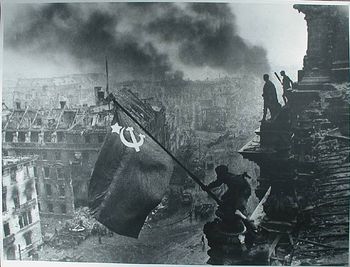
Thinking maybe the Beatles were coming through, I feigned interest and stared out over my windowsill. Maybe the excruciating monotony of my existence was about to be broken, if only for a few short, sweet minutes. Then, at my most vulnerable moment, my girlfriend reminded me that today is Nazi day here in Augsburg. And the troglodytes of the Ancient Order of People Who Got Their Asses Kicked Last Century But Good would be slipping out of their caves for a short march, passing right past our windows. Super, I thought, more weirdos. I considered hanging my American flag out the window, along with a poster of the Red Army capturing the Reichstag, but only for a moment.
Marching for or against Nazis is about as pointless as marching for or against foot fungus. Little fungi just love being between your toes; people hate having them there; and you're not going to change either one's opinion about the matter. But some people are attention whores, and can't pass up the chance at making asses of themselves as long as it's in front of crowds. Just look at Jimmy Carter.
But I don't want to take sides, lest I be seen as unfair. So here's a little something for our Nazi brethren, on their special day:
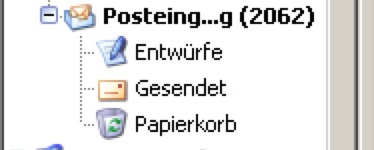
"Um...honey, you know I don't like telling you how to run your computer, even though that's the profession I've been in since the late 80s. You now I respect your work habits, and trust you to do the right thing with your data. But do you think it might be time to clean out your Email inbox?"
Seeing as how, in a matter of weeks, I'll be working in an exclusively Linux-based environment, I figured I'd fire up my Fedora installation again and see how's tricks. Linux has been playing the Ike to my Tina for over a decade, always disappointing and abusing me every chance it gets, and I just keep coming back for more. This time, though, it's for real; I can feel it. Anyway, I don't have a choice, so let's just tell the neighbors I fell off the swing, and concentrate on the good times.
One of the biggest gripes I've had about Linux was its sound card support*. Every Linux distribution you can think of still defaults to 1993's concept of sound hardware. Namely, only one application can play a sound at any given time, and it locks the sound hardware from being used by other applications, for what reason not even God knows. This is behavior that belongs in a single-user, single-tasking operating system like DOS, not in a modern multiuser environment like Linux.
This problem was addressed back in the day by using "sound servers", like ESD or artsd, to provide a layer between the applications and the OSS-supported hardware. This introduced a huge amount of latency, however, and was generally considered a stopgap measure even at its inception back in 1998 (or maybe even earlier, I can't find that info). Even worse, software had to be written to explicitly support it or it was useless.
The limitations of the OSS+Sound Server architecture were overcome by a project known as ALSA, which introduced software mixing at the kernel level. This created an OSS-compatible, multi-streamed abstraction for sound hardware, and obviated the need for sound daemons altogether. That was back in, oh, 2000 or so, and to this day, every single Linux distribution still ships with sound servers and software mixing disabled.
Ubuntu, Fedora, Debian, et. al still configure sound hardware to be accessible by one application at a time, despite ALSA's hard work. This means, for instance, that your Flash Player will freeze your browser if you happen to be listening to music in the background. Or if you get a system beep, it will lock you out of using your sound card for as long as the artsd/ESD timeout is set up. Games will not work. This sucks, of course, and is no way to compute in 2007.
The way to fix this is fairly simple. Simply put the following into your /etc/asound.conf, or in your ~/.asoundrc:
Now, I profess neither to having written that snippet, nor to having any understanding whatsoever as to what it does. But since I put that magical incantation into use, I've had no problems whatsoever with sound-card locking, or Flash plugins, or anything else. It just works.
Now why haven't the distributions adopted this behavior as the default, instead of their asinine insistence on single-channel sound support? The reason is simple: Linux distributions hate their users, and want to destroy them by any means possible.
This would also explain their sticking with X Window System.
In order to keep a vase full of flowers fresh, drop a penny (or other copper coin) into the water. Since 1982, pennies are copper-plated. Pre-1982 pennies were 95% copper or more, so would theoretically work better.
Computers have been around for a while, now. The first digital computers that did useful work were used by the British during World War II to crack the Germans' Enigma cryptographic scheme, with the help of literary greats Alan Turing and Kate Winslett. Computer networks came about not long after. In fact, the network technology that most people use today, Ethernet, was developed back during the Nixon administration by Xerox. But that's really more of a hardware spec, invisible to most of us that use it, and used only in the most vaguely analogous sense by the Internet and wireless connections that we find ourselves using more and more.
What runs over those networks, well, that's the stuff that really concerns us. We wouldn't care if our SMB, HTTP, or NFS protocols were running over a length of twine connecting a couple of dead beavers, just as long as they kept the links up and the bits moving. But for some reason, these protocols, like unto the network itself conceived in the dark, smoke-filled chambers of engineering history, are still less than adequate in real world situations. I'll give you an example: There's not a computer or operating system built today that gracefully handles an unexpectedly disconnected network volume.
I'll grant, for the sake of argument, that I'm on the only moron in the world who would forget to dismount a network drive before clapping his laptop shut and carrying it out of the office. But you would think, in the 30 or more years we've been using networks to share our data, that exactly this scenario might have come up at some point in a worst-case-scenario brainstorming session by one of the major vendors. But I guess the very idea such a thing could happen was judged preposterous, and relegated to the realm of science fiction, freeing the engineering team to work on more critical issues like the Desktop Cleanup Wizard.
So maybe the story I'm about to tell could land me in the rubber room, but I'll chance it, as the Truth Wants to Be Free. As you may have already inferred, in my hurry today, I forgot to dismount a shared network volume before packing my laptop and heading out of the office . Upon opening my laptop once more, I was greeted by the Symbol of Waiting, which refused to go away. All the while, in the corner of my friendly graphical user interface, said network volume's icon was displayed, indicating a continuing, vigorous mounting. Obviously, the Symbol of Waiting was my computer's way of telling me that, while it seemed unlikely that this drive could be mounted without access to its network or, indeed, any network whatsoever, it was still experiencing a moment of indecision. It was telling me that it was considering the two conflicting possibilities of a) the network connection being gone, and therefore all processes using it should be informed of this fact, or b) the server having followed me to the café I'm sitting in, installed a network cabling plant, snuggled itself under my table, and then connected itself to my laptop, and was just in the processing of booting itself back up in order to serve that dreadfully missing network share; a possibility which, I might add, the computer was willing to indulge ad infinitum. Apparently, Occam's Razor is a difficult principle to express in Objective-C.
All of this culminated in a computer caught in a permanent moment of indecision. I like to believe that every time you boot your computer, the cycle of its life is started anew, with the hopes and dreams of a better life this time around; the corollary of course being that you've had to viciously snuff out the life of its previous incarnation. Thus as I was administering the Mac equivalent of a three-finger salute (Ctrl-Cmd-Power) to this shivering, broken husk of a computer a moment ago, I felt no regret. It was better to end it there, to ease its suffering. I felt pity however, in that it probably didn't understand what it was going through, what the source of its confusion and suffering was.
But I also couldn't help think it could have been prevented. Perhaps the status check of a network mount could be moved into a thread, instead of being embedded in the main event loop of the user interface, blocking all input? Perhaps an operating system could check to see if there are any open files on a mounted network drive before betting its entire existence upon the fact that it may, one day, return? Is the termination of a single process blocking on a stat call really worth the life of the entire ecosystem? These are questions for the politicians, apparently, and not for the medics in the field.
In a technical interview recently, a man asked me if I knew the point of "hard-mounting" network shares, particularly those of the NFS variety. I gave the textbook answer he expected, that it was preferable for applications to block and fail in the case of a missing disk than to go on believing that it still existed, without the knowledge that their write operations had failed, and their data were most likely corrupted. It's easy to be so cold and calculating when you haven't seen the suffering involved in such a catastrophic break. It's easy to extoll the virtues of data integrity über alles. But from the perspective of the victim, ignorance is, unfortunately, bliss.
UPDATE: This was, oddly, the Whine of the Week on Macbreak Weekly.
So, I was wondering if there’s a way to send that directly to the police. For example, if you’re pretty sure you’re about to get mugged, you could just take a picture of the guy and send it quick-like to the cops. Then, you could say, “whoa, G, you might as well keep on moving: five-o’s got your mug.? Of course, this may come across as somewhat antagonistic, which muggers generally don’t like. Anyway, if you send an MMS to 911, does it work? It should. Then, we could all be bitch-ass little snitches at the touch of a button.
Catching criminals in the act these days is s ometimes as easy as pressing a button on your camera phone.
Now the city is moving to simplify your ability to share telltale evidence of subway flashers, house burglars or even a suspect pothole, Mayor Michael Bloomberg said yesterday.
"If you see a crime in progress or a dangerous building condition, you'll be able to transmit images to 911 or online to nyc.gov," Bloomberg said in his State of the City address.
You ever have one of those days when you say to yourself, "If the world would just shut up and do as I say, it would be a better place for everybody"? Well, I don't. I speak, and the world listens. Sometimes it just takes a little longer than it should. Stupid world.
Hurricane Kyrill is blasting across Germany at the moment, leveling trees and flinging stucco about. Man, you'd think Gabriel was tooting his horn outside, the way the locals are reacting. Mind you, Kyrill's not really a hurricane, but rather a winter gale. That would be the way LEO translates the german word Orkan; well, that and hurricane. But a hurricane is necessarily in the Caribbean, moving west. Technically, anyway.
But I'm not here to split hairs, I'm here to talk about battering winds, upwards of 200 kilometers per hour. Not sure how fast that is in real measurement, but I can confirm it's a-howling through the alleyways outside. You can actually hear it whistling through the cathedral belltower, a good half-mile away. It's sort of a low hoot. The roof tiles they have over here are bound to start flying around at some point, injuring passers-by unlucky enough to be out in it, à la Ben Hur. I've still got to get home from this bar I'm sitting in right now, but I'm close enough that it would be a lucky shot, indeed.
They've stopped all trains in the entire country, even the streetcars, and the kids are staying home from school tomorrow. As are many businessmen, their firms more concerned about their safety than the four-hour workday most people put in on Friday over here. All in all, it's a pleasant diversion for everyone, an act of God that brings a bit of excitement to the daily routine. I'm just glad the bars are open, otherwise this entry would have been about four lines long.
It's sort of like it used to be in Atlanta before the Yankees came, when we got a few flakes of snow on the ground. Once the slightest flake fought its way through the climatical defenses enough to land and shout, triumphantly, Allahu Akhbar! Quake with fear before me! before becoming a small puff of vapor, well, that's when the fabric of Atlanta society would start coming apart at the seams. The groceries stores were run upon, with milk and bread being carried by the truckload to the homes of weather-maddened Southerners. The schools were locked down tight; lest the inexperienced, though well-meaning bus drivers tumble off a cliff, out of control on ice-slick roads with a full load of schoolchildren. We didn't like snow, not even the rumor of it.
Growing up in Cherokee County, we had a rather enviable relationship with snow. It's a large county, with a hilly bit up north, in the Canton area. But the rest of the county sits around Lake Allatoona, and is predominately mild in its winters. School closings, however, are granular only to the county level, which meant that whenever some meth-addled bus driver in Ball Ground happened to notice a patch of frost on the grass on her way out of the trailer park, the school board would immediately be notified, and all educational activities throughout the county brought to a halt. Sometimes, some farmer's pond was frozen over in a forgotten corner somewhere; the very presence of ice somewhere induced enough unease among the elected county officials that they just played it safe and let the kids have the rest of the week off.
During the Winter of '87, we actually had 16 days off in a row for snow. Down in our end of the county, we did indeed see snow the first day. I remember it well: We were sitting in home room, the first class of the day, when the first flakes began to fall, the shimmering little harbingers of freedom. In panicked tones, the principal came on the PA and announced that we should all get on the buses, or hop in our cars, and get the Hell home, not forgetting of course to stop on the way for whatever bread or milk might still be available in the local grocery store, every man for himself! I could just see him in his office: laying down the intercom microphone and strapping himself to his chair, cradling his service .45, a captain going down with the ship.
Predictably, once we were all home the snow stopped. In fact, it was 65 degrees by midday, and we were playing football in the yard with 8 men per team. It was a pleasant diversion for a Tuesday afternoon, but we were resigned to getting back to the grind bright and early the next morning. But there was no school the next day. Nor the day after that. In fact, for the next two weeks, despite spring-like temperatures and sunny skies, we were out of school on account of snow. Every day the disruption continued, the fun factor was reduced by half, until finally we were all wondering whether they had forgotten to tell everybody to go back. But no, there was Guy Sharpe every morning, announcing the one and only school closing in the state of Georgia: Cherokee County. For two solid weeks. I always wondered what people in other counties thought of that. At one point, the guy shows them a map of Georgia with little suns all over it and 60+ degree temperatures, then announces that our hillbilly asses still won't come out from under our rocks.
They cancelled our Spring Break that year because of that. Bastards. I didn't think much about it then, being a latchkey kid, but I can imagine that a lot of parents had actually planned their precious two-week vacations to coincide with Spring Break. But then, Cherokee County was a different crowd back then. I mean, to have vacations implies that you, you know, have a job.
But it became clearer to me in my last two years of High School how something like that could happen. It was easy to start rumors about snow sightings in Canton. Even mentioning an ice storm in Birmingham would have the teachers looking nervous. Do that in home room, and by lunch it would be all over school. Somebody would come up to you and tell you that the county seat was under a six-foot sheet of glacial ice, and that school would be cancelled forever, what with the coming ice age and all. It's a miracle that the public school system functions at all.
Weather is always what the Germans call a gaudi, a good time.


 That's Pappy in the dark jacket, just right of center in the front row. He wore shoes because it was Picture Day. How do explain that to an scone-eatin' Englishman?