"You'd have to set up little 'blog policemen' on these entries to shoo away onlookers - 'Move along, nothing to see here!' But no, people stand there looking at the dead animal at the side of the road, at two people full of pride making complete fools of themselves in public, and then go and write whole blog entries about it." Stefan Niggemeier, media journalist and photoblog author, on a dispute in the blogosphere. The two "complete fools" Niggemeier means here are 'DonAlphonso', author of the A-list blog "Rebellmarkt", and Peter Turi, also a journalist, and author of the "Turi2" blog. The start of the argument goes a long way back, but the current escalation began when 'DonAlphonso' repeatedly referred to Peter Turi in his blog as a "blogging failure" - Turi struck back by calling Meyer a "moaning minnie". What started as a minor skirmish developed into a heated conflict, with both sides receiving support. Over the course of the dispute, old scores were settled, fervent slanging matches went on in several blogs, and threats of lawyers were made. Finally, Peter Turi shut down his blog - though it's unclear whether this was directly or only indirectly related to the argument.
The argument between Turi2 and Rebellmarkt is not a one-off. The introduction of the “social web?, and all the technologies that constitute it, has made it possible for social relationships to occur in part or entirely on the internet for the first time. Weblogs aren’t just a new form of website, they’re also a new form of cohabitation – “virtual living rooms? home to human relationships. Together with weblogs though, a new form of argument has also developed. Unlike the well-known phenomenon of “flame wars? - conflicts which take place in a forum or chat room – this new form of dispute is taken more seriously and carried out with much greater engagement. These new conflicts have a different dynamic, follow different rules, and have serious, irreparable consequences for those involved. These are blogwars.
CausesIn his article “The extraordinary anger in weblogs?, ’Axonas’ names “communicative unbedding? as the main reason for blogwars:
“Direct social checks are largely absent in a digital network. Generally, you don’t meet people there who can have any influence on your own immediate personal sphere, so the majority of online 'buddies' are virtual friends in this sense. Forums and email lists try to compensate for the lack of social checks by enforcing netiquette, via the use of permission authorisations and moderation. If you look at current forums though, this doesn’t seem to have generated any learning effect, even after years of existence. In weblogs, even these rudimentary controls of communication are absent. In the world of weblogs, there’s no ‘Big Brother’ of internet access, equipped with powers similar to forum moderators. Using my weblog, I can access the diverse public sphere which constitutes the "blogosphere", and do whatever I like in terms of aggressive communication, which, apart from legal measures, knows no bounds.“
In a certain way Axonas is right - on the internet, an environment which can regulate people who violate social norms is often missing. Behaviour which would lead to a strong backlash in real life is easily possible on the internet without any problems – the phenomenon of “trolling“ is well-known. However, Axonas overlooks the fact that in contrast to the rest of the internet, there is no “communicative unbedding“ in weblogs. On the contrary: Weblogs are a communicative space in which social exchanges take place. If you blog, you’re not doing so in isolation, but surrounded by an environment of other bloggers and visitors. This social network functions in a similar way as in the real world - it defines a general moral code of what’s right and wrong, and enforces it. A blogger who doesn’t stick to the rules valid in his part of the network will meet with resistance - objections in their own weblog or those of others, loss of readers, and deletion from blogrolls.
So how come there are still blogwars? Precisely because of this social network. In contrast to the early days of the internet, much more social activity takes place in the “social web“ than before, and where there’s social activity, there’s also competition, arguments and fights. Unlike in earlier days, bloggers really have something at stake in these disputes; a weblog almost always represents an important aspect of someone’s life, which they maintain with lots of effort and may rely on for a number of reasons. And since the stakes have risen with Web 2.0, they are fought for more strongly.
Development
Blogwars often develop at extreme speed. The blogosphere is a highly-networked environment in which information flows more quickly and uncontrollably than ever before. Thus, it is often impossible to predict how a conflict will develop: Some blogwars only last a few days and end with little in the way of consequences, while others drag out over months and leave the losers badly damaged. Despite this, an attempt will be made here to classify the different phases of development of blogwars: The initiation phase, the escalation phase, the main phase and the closing phase.
Every blogwar starts with the
initiation phase. As with every form of conflict, the starting point is a conflict of interests - in other words, two parties with different interests which contradict one another. In the case of a blogwar, this may be many things: Political disagreements, personal disagreements, rivalries or misunderstandings. It’s also not unusual for one blogger to attack another simply for the fun of the fight; in this case the blogwar is self-serving. There are also some bloggers who deliberately use blogwars to get attention, to keep their blog interesting and gain new readers.
Whatever the original reason for a conflict, it’s almost always infinitessimally small, and in no relation to the effort made on its behalf. The disagreement escalates to a real blogwar in the
escalation phase - the two adversaries attempt to outdo each other, and use up more and more resources and time doing so. At some point, when the relevant arguments have been exhausted but the dispute continues, the conflict crosses over into the personal sphere, and the warring parties begin to attack each other directly and on an individual level.
The escalation phase is also the stage in which supporters, in double or even triple figures, normally enter the blogwar on both sides. Participants rarely join in due to the content of the disagreement; as in a real war, it’s mostly about loyalties, alliances and old scores. Alliances are often made according to the motto “the enemy of my enemy is my friend“.
In the
main phase, the conflict reaches its peak: Both sides attempt to do as much damage to the opposing side as possible, by trying to attack them at vulnerable points and harm their credibility. To this end, substantial numbers of blog entries and comments are made, listing old and new arguments, often combined with damaging information and threats. If the conflict is large enough, a majority of the blogosphere will assume a position and either declare solidarity with one of the two parties or neutrality.
The disagreement is normally concentrated to one or two weblogs. These are often, though not necessarily, those of the original disagreeing parties – though what may also happen is that a blog with a wide readership starts to follow the blogwar, and thus the attention of the blogosphere is diverted there. Having a home advantage in a blogwar is something which shouldn't be overlooked: Not only does the blog generate attention and gain new readers due to the conflict, but the “host? is also in a better position in the conflict - he has the support of his own readership, who are well-disposed towards him, and he can affect the discussion at any time by making or deleting entries at will.
After a while, the attention of the blogosphere will drop away, and the blogwar enters the
closing phase. Whether or not there is a victor at the end depends mostly on the goals of the participants, and these vary. If the objective was to get attention and thus increase the number of readers of your blog, then all participating bloggers will normally have achieved this and can be seen as ?victors“. If the blogwar was really about something outside of the argument, though, such as personal differences, revenge or rivalry, then the blogwar itself is only a side skirmish. The Turi-Alphonso conflict was a case like this: The antagonism between the two parties stretches back to a time when neither of them had a weblog. It is therefore irrelevant whose arguments were superior, whose credibility was damaged and whose reputation was tarnished after the argument. No-one won, as there was nothing to win. The only effect is that both sides have lost time and credibility - and were mentioned in an article by Stefan Niggemeier.
The protagonists
Peter Turi versus DonAlphonso was a disagreement between two bloggers. This form of blogwar is far from the only variant, however – bloggers just as often seek targets who are active outside of the blogosphere or even outside of the internet. Different combinations of this may be:
Blogger vs blogger
Blogger vs companies or organisations
Bloggers vs private individuals
Blogwars develop differently depending on who is involved. When bloggers fight amongst themselves, they are on more or less equal terms. The disagreements often have the character of a ritual fight; the two adversaries make lots of threats, make contact only briefly, then each goes their own way. This is different when one of the participants does not have a blog. In these cases, a blogwar rapidly becomes a gauntlet; since the person under attack cannot defend themselves, they are helpless, and at the mercy of the attacking blog – something which is known in the German blogosphere as “die Sau durchs Dorf treiben? - literally, "parading the pig through the village?. The party under attack is unable to adequately defend their own position but comes under attack from all sides. The consequences in such cases can be devastating – especially if it is not an organisation or company under attack but a private individual, a human being with feelings.
The victims
Blogwars, just like real wars, rarely occur between equally matched opponents. It’s much more common for one or more blogs to “attack? a considerably weaker opponent. When this happens, it’s often a nasty shock for the party under attack. A victim can already suffer massive damage before even understanding what’s actually happening. Even when an off-guard victim discovers the attacks in good time, they often react incorrectly - defending themselves with inappropriate means, neglecting good argumentation or spelling and just making everything worse.
At some point in the course of the blogwar, the victim will notice the consequences which threaten him. The first thing they’ll notice is what’s happening with Google. Searches for the name or online pseudonym of the victim will no longer just display harmless internet pages, but also the results of the blogwar - defamations, aspersions and attacks. The victim will be afraid, and justifiably so, that the allegations listed will be noticed by employers, colleagues or family members.
The victim will also be confronted with a multitude of different insults or threats, often so many that it’s impossible to respond to them all. The most unpleasant comments here aren’t those made by the “leader of opinion“ - the blogger who started the blogwar – comments or blog entries made by the ?ground troops“ normally hit harder. These comments are often loaded with prejudice, and explicitly insulting.
A victim will see the conflict “overflow? and be taken up by other blogs, which then add new aspects and information of their own. They will see how some bloggers, for whatever reason, trawl the internet for information, looking for “dirt? to use against them. In this way, information which seemed completely harmless before, such as publicly managed photos, a personal homepage or entries on dating sites, becomes ammunition for the attacking forces.
The effects experienced by the victim depend on how robust they are and how much experience of conflict they have, as well as on how much is at stake. A steely A-list blogger is certain to deal with a blogwar differently than a labile teenager with little internet experience. If you let the conflict get too close to you, you will suffer from effects similar to those of bullying – panic, stress, sleep disruption and neglection of other tasks.
In addition to mental problems, the victim can also sustain real-world damage. Especially for people looking for work, or those who rely on maintaining a good reputation in the “global village?, negative Google results can be problematic. For a programmer, online journalist or someone in the marketing sphere, a lost blogwar could mean the end of a career in certain cases.
Strategies and tactics
First, it is important to advise against engaging in blogwars at all. Apart from the fact that most conflicts are best solved by other means, it’s rare for anyone to really profit from a blogwar. Even in conflicts where one party is clearly at a loss to the other, the winning side will also have to accept losses; those involved in a blogwar inevitably lose credibility. They’ll gain new readers, but not the sort of readers a blogger wants – fight chasers and rubberneckers, a public only reading out of a desire for sensation and scandal.
Not everyone, though, has the opportunity to decide for themselves whether or not they want to participate in a blogwar. Some are drawn in against their will. In cases like this, it's important to know the rules of battle and the methods used in fighting a blogwar.
• The most important weapon in a blogwar is information. Information on the opponent, on yourself, and on any third parties involved. The information of most interest is that which extends beyond the online sphere - the real identity of the opposing parties, where they live, the names of their employers, etc.
• However, it’s also just as important to know what information the other side has on you. At the start of a blogwar, it is therefore wise to not only research what’s worth knowing about your enemy, but also to investigate what information Google and Technorati contain about you. If you recognise “vulnerable points“ during the research, there's little sense in removing these. You can assume the enemy will have taken screenshots of them as proof - plus most webpages are archived in the Google cache. An exposed cover-up attempt can be worse that the information covered up itself. It’s better to leave the information there but prepare yourself with a good explanation.
• If you take part in a blogwar, you need to be well-informed, and quickly informed, the whole time. Within the space of a few minutes, new developments can arise, new "fronts" can be opened or others reduced to shreds. There are different ways of keeping track of information like this, which are best made use of in parallel: Tracking programs such as Statcounter, blog search engines such as Technorati, and manual research. It’s important to regularly check the visitor movements and referrers on your own website; this is a quick way of seeing whether another blog has linked to it, whether someone has distributed links via email, and which search terms people are using to reach your blog from search machines. It also goes without saying that you should regularly visit blogs involved in the conflict and follow discussions in the comment threads. In some cases, you may have to react to new developments very quickly.
Once the relevant information has been gathered, you need to decide how to proceed further. For many people, who have no experience with the blogosphere or who can expect a clear defeat for other reasons, the most advisable alternative is not to respond at all. After a while, the attacker will have used up all of their ammunition, lost interest and moved on to other things. Lots of things can then be dealt with more simply afterwards.
If you nevertheless decide to actively take part in a blogwar, you should keep a few important rules in mind:
• Nothing is more dangerous than poorly thought-out comments. It’s essential to double-check all facts you state and all arguments you make. Responses should be coherent, convincing and well-formulated.
• If possible, don’t carry out the conflict on your enemy’s territory. Only leave comments in other blogs to link to your response - on your website, managed by you.
• Anyone who becomes too personal loses credibility. Even when sorely tempted, always refrain from using expletives. Always remain calm and level-headed, use objective arguments, and draw attention to the lack of objectivity of other arguments.
• Only play as fair as your enemy - but don't play less fair either. It can be useful to have “dirt“ on your opponent up your sleeve, but it’s not always wise to use it and is only rarely in your own interest.
In many cases, especially those where you have no way of defending yourself, it’s advisable to contact a lawyer. German law has a number of options open here: You can file for injunctive relief or make a claim for damages, or make a complaint of defamation or libel. If you really want to continue the dispute by legal means, though, you need to be clear that this may become very expensive, and that victory is far from guaranteed. If you still decide to go ahead, make sure you hire a lawyer familiar with such disputes – this is more the exception than the rule. It is strongly recommended to hire a lawyer who specialises in intellectual property rights, or to specifically look for a professional with internet experience - for example, via the German Lawyers’ Union.
After the blogwar
Even though this is often forgotten in the heat of battle, every blogwar ends sometime. Once oil is no longer being poured on the fire, the interest of the blogosphere will wander over to a new topic, and the shadow will be lifted again as quickly as it was cast. Once the blogwar is over, it’s important to quickly return to normality, pick up the pieces, and carry on again in one way or another. A blogwar doesn’t always have entirely negative results, though - if the argument was witnessed by a majority of the blogosphere, participants will discover that the number of visitors to their blog will have increased by multiples. Some bloggers will treat this as a challenge to show that they can do more than just argue.
In the end, even though the euphoria after a victory may be large, and the 5 minutes of fame may be addictive, blogwars aren’t really worth it. Blogs are tools, not weapons. They’re about creating something. Representing yourself. Sharing your knowledge. Being part of something. Making friends.
Remember, blogging is supposed to be a Good Thing.
This article is a translation of a german text that was first released on my weblog "buchstaben in bewegung". It attracted some attention in the german blogosphere, so an aquaintance of mine, Niall McCourt, translated it. I´ve asked Rube if he could publish it here, so he gave me permission ;-). I´d like to bring this article to a greater audience, so if you feel you´d like to pick it up and republish it somewhere, go for it.
Niall is a freelance translator. If you think he could do a job for you, email him.
Howdy, friends and neighbors! Man, I've hard a tough couple of weeks. Ever since thanksgiving I've been busier than a butt-legged man in a nun-kicking contest. Deadlines to meet, servers to build and ship, the entire back catalog of X-Files to watch. We're all the way up to the one where that guy from Monk kills people with his dark-matter shadow.
Not that it's all been work-related, mind you. I've recently re-discovered video games. With the little woman away this past weekend, I eschewed eating, bathing, and sleeping to sail a cartoon boat around an imaginary world in Legend of Zelda: The Wind Waker. Despite the obvious gayness inherent in all Zelda games, I'm secure enough in my masculinity to declare this THE BEST GAME EVER. I haven't been sucked into such a bottomless miasma of escapism and bad personal hygiene since the first Zelda, back in '88. That's right: miasma!
Anyhoo, that's about it. Almost. I also got a call from a rather large open-source company that you've probably heard of to come work for them in England. Maybe I'll move there with my sweetie, who knows. It'll be a big investment at first, since I'll have to buy a bowler hat and have my teeth darkened, but it'll probably be worth it, just for the weather.
I hope everyone had a good Thanksgiving. It's my favorite holiday, I think. It's truly a thing that everyone can do together, without worrying about offending anyone, unless it's because it's a typically American holiday. And let's face it: If that offends, then I'm happy to offend.
I cooked a turkey this year, for the first time ever. Being until recently a vegetarian, I was baffled by the various organs that I pulled out of the carcass, all neatly delivered in a little plastic bag. I realized that it was all probably edible, but I balked at eating the bagged innards, in the fear that one of them was the gizzard, which supposedly leaves a bad taste.
Treating Europeans to Thanksgiving is an enormous responsibility, but I think I pulled it off without disgracing my ancestors. By all accounts, my Southern Cornbread Dressing was not only edible, but delicious. I never realized that the defining taste of Thanksgiving Dressing is sage, of all things, and I was struggling Thursday afternoon with a tasteless mash of cornbread and gravy. But a few panicked phone calls to Mom can solve almost any crisis, and she finally, after all these years, spilled the recipe.
The in-laws were over, and I was able to feed and water them. There was French wine, German beer, and Southern American food. In short, there was much to be thankful for. And that's what I like about Thanksgiving: That reminder to sort out the things that make you happy, and be thankful for them. It's a good tradition; there's plenty of time to sweat the small stuff.
Hugs,
Rube.
Technorati Tags: thanksgiving
Being a pompous douchebag, as the distinguished gentleman from North Carolina unmistakably is, does have its drawbacks. Can you imagine what kind of dishonest life you would have to lead if, like Edwards, you had to apologize nationally, in humiliating fashion, for trying to find your kids a Playstation 3 at Wal-Mart?
John Edwards _ a vocal critic of the retailer _ asked his local Wal- Mart store for help in getting the potential 2008 presidential candidate a Sony PlayStation 3. Edwards said a volunteer did so by mistake.
Edwards told The Associated Press that the volunteer "feels terrible" about seeking the game unit at Wal-Mart a day after his boss criticized the company, saying it doesn't treat its employees fairly.
Unbelievable stuff. Edwards is so beholden to unions and soy milk guzzling neohippies that he has to ask their pardon for doing exactly what 99% of parents in the United States are doing. This is what's known as 'being out of touch'. It betrays the intellectual dishonesty involved in being an empty-suit sound bite peddler.
Being an antisocial libertarian helps me immeasurably when it comes to lemming-like materialism. Were I not such a late adopter of technology, I would go into Wal-Mart myself and root around for Playstations 3; I would do this without a bad conscience, and would not have to apologize to anybody. Trust me, if Hitler's Electronics had them in ample supply, and at an acceptable price, I would walk in smiling with Visa in hand.
And now, as John Edwards contorts himself into various contrite postures, blaming his actions on subordinates, Playstations are most likely already in the homes of Wal-Mart executives across the country. Every Wal-Mart employee in North Carolina now has the opportunity to buy one before the good Senator. It's too bad they only make about $2 an hour, else they could bedeck the trailer with Christmas cheer, whilst a gloom hangs about the Edwards Manse.
Technorati Tags: consoles, politics, ps3
'Kubuntu' is the Swahili word for, 'Suck it, luser!'
For a lark, I downloaded the 4.5GB DVD for Kubuntu Linux. Ubuntu, upon which it's based, is the current darling of the Linux scene, so I figured I'd see how long it's come along since I last installed it.
Let's see...
- No MP3 support, even for network streams like you'll find at Shoutcast
- Major headache getting my ATI Radeon X1600 to work with 3D screen savers
- Refresh rate capped at 75Hz
- Printer sharing doesn't work
- Zero progress on sound card configuration
- Default resolution of 1600x1200 is a bit...ambitious. I can't find any way to change it permanently
- Applications like Firefox, Thunderbird, KOffice, Scribus, et. al. not included
- Did this thing really just ask me to insert my install DVD?! What is this, 1998?
- System always locks up after KDE session logout
All in all, a shit sandwich, served pipin' hot. When will somebody in the Linux business finally decide to integrate their product? I realize that KDE can't really be expected to change the underlying configuration directly, as long as the stuff from CUPS, Xorg, ALSA, and Samba are kept separated from the user interface. Why doesn't somebody try to integrate this stuff into the desktop, and make a product out of all these Tinker Toys?
Ah well, at least in Windows I can change my default sound card without being a Dungeon Master.
Technorati Tags: ubuntu, linux
For no particular reason, here's a list of national sales tax rates of European countries.
| Country |
Sales Tax % |
| Austria |
9.09-16.67% |
| Belgium |
21% |
| Denmark |
25% |
| Finland |
17-22% |
| France |
5.21-16.38% |
| Germany |
7-16% |
| Greece |
11.5-15.25% |
| Ireland |
17.36% |
| Italy |
4-20% |
| Luxembourg |
15% |
| Netherlands |
15.97% |
| Portugal |
19% (13% in Madeira and Azores) |
| Spain |
16% |
| Sweden |
25% |
| Switzerland |
7.6% |
| United Kingdom |
17.5% |
via Europe for Visitors.
Technorati Tags: germans, travel
Do you ever get the feeling that, just beneath the surface of the visible world, the world which you and I would consider reality, strange forces lurk, forming a sort of world-within-a-world? I didn't either, honestly. I mean, I've seen The Matrix, and I have to admit that their explanation, that a war between man and machine created a 300-year long meta-reality in which mankind is held thrall to a sentient, evil race of machines, would go a long way toward explaining things, like Everybody Loves Raymond.
But I'm not here to take cheapshots at non-threatening TV shows. I'm here to tell you that everything you've sensed, everything you've feared about meta-reality complex is true. I know this, because I've discovered a blind spot, a bubble in the Matrix. I've discovered a gathering place in the Internet where the world's top engineers, obviously unbeknownst to our bionical slavemasters, continue a discussion which already spans 9000 words, almost 40 pages of calculations and hypotheses.
It's a discussion about bacon.
Conclusions
Microwaved - The bacon came out extremely crisp throughout both the fat and meat of the bacon. It felt a bit thicker than I expected from a thin cut piece of bacon. Examining the fat collected in the paper towels leads me to believe that very little fat was rendered out in comparison to the pan fry method. The technique is simple and hands free, but a problem that I have is that the paper towel stuck to several of the pieces of bacon. This may have been because I allowed the bacon to rest and drain on the same paper towel it was cooked on. Another issue is the limited number of bacon strips you can cook in a microwave oven at one time (but the time savings probably more than makes up for this).
Pan fried - The bacon felt the thinnest and lightest of the three. The bacon fat was crispy while the meat was slightly chewy. I actually prefer my bacon this way (not totally crunchy and crispy, but with some texture to it), but others may not. All in all, a good method to cook bacon but time consuming.
Broiled - The bacon was burnt in some spots and the meat felt undercooked. The areas need the burns were bitter in taste and the texture was soft and soggy throughout (except for the blackened parts). Not much fat was rendered off either. I would not recommend this technique.
So, microwaving is king if you're looking for bacon that feels thicker than what you purchased and crunchy throughout. Pan frying is great for a thin, light bacon with a little chew in the meat.
Methodical, thorough, and brilliant. It goes on for pages and pages, with a column of crack scientists discussing the merits and demerits of various bacon-charring technologies. I tremble in horror.
Technorati Tags: bacon, engineering
In a startling development, the smug leftist hipsters at überblog Boing Boing have gone two (2) straight days without mentioning Diebold. The last mention of the maligned "voting" machine manufacturer was right before the "election" results came in. Which, coincidentally, showed huge Democrat "wins".
Could it be that Diebold's agents have gotten to Xeni and Cory?! It couldn't possibly be that the whole body of anti-e-voting writings was just screeching partisan hysterics, could it?
Technorati Tags: electioneering, boingboing
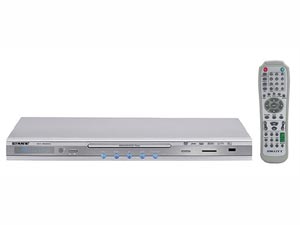 Being a late adopter has its advantages. For example, I just picked up a Scott i960CS, which is a commodity DVD/standalone DivX player. It cost about fifty bucks, and is so generic that it's nigh ungoogleable. I bought it to replace my fifty-dollar DVD player, which was getting a bit long in the tooth. About three years ago, I really, really wanted one of these, but they were going for a cool $400 at the local shops, so I decided to buy shoes and electricity instead. Now, I can pick one up at about 12% the cost that I would have gladly forked out back then, had I had the cash.
What a cool thing these doodads are. It will play just about anything you throw at it, format-wise. You can easily shut off the irritating region restrictions that would otherwise keep you from playing DVDs from other countries, which in my case would be the US-bought movies that comprise about half my collection. It's got a USB port, into which you can plug a thumb drive, iPod, or external hard drive, and browse them to play media.
My big idea was to copy all my music and movies to an external 160GB hard drive, hook it up to the USB port, and never have to switch discs again. Unfortunately, two things keep me from doing that. First, the Scott doesn't read long filenames from external devices (data DVDs seem to work fine), so you'll have to wade through FAT32-style mangled names, trying to figure out what “BLOWJO~1.AVI? could possibly be. And second, whenever you access the external drive, it thrashes around alarmingly, as the player apparently scans the entire thing at a go. It's scary enough that I'll stick to copying things over to the USB flash stick for the time being.
I realize this was all new and hot about three years ago, but that's what's great about being a late adopter: 50 bucks and you get that consumerist rush. Now, I can't wait until Christmas 2009 when I can pick up that sweet-ass Xbox 360 I'll be having my eye on.
Technorati Tags: consoles, entertainment
Twelve years ago, the Republicans took power under the leadership of Newt Gingrich. Newt was a man that even 17-year old liberal drama fags at my high school hated in the '80s, so I was predispositioned to like him, even before I was old enough to vote. Anything that annoys pretentious, faux-political teenage liberals is fine by my book.
When they first came into power, the nation was damn near on internal Red Alert. Conspiracy theories, ranging from Con-Trails to cattle mutilations(!) by black-helicopter-flying secret government cryptofascist organizations, Unabombers, X-Files, Branch Davidians, Randy Weaver, Timothy McVeigh; you guys remember all that stuff, right? Well, it looks like it's that time again, kids! (Only this time, the Democrats have got the Patriot Act in their bag of tricks. And that seemed like such a good idea when the GOP was running the show...)
Gingrich, along with rich genius bastard Dick Armey, devised a scheme to defuse the situation. They called it the Contract with America, and it amounted to a Republican business plan for the newly-acquired Congress, Inc. I'm including it here on the vain hope that I'll actually read it all the way through at some point, and be able to assess what sort of progress the Republicans made over the last 12 years, in comparison to what they were actually all fired-up to do.
As Republican Members of the House of Representatives and as citizens seeking to join that body we propose not just to change its policies, but even more important, to restore the bonds of trust between the people and their elected representatives.
That is why, in this era of official evasion and posturing, we offer instead a detailed agenda for national renewal, a written commitment with no fine print.
This year's election offers the chance, after four decades of one-party control, to bring to the House a new majority that will transform the way Congress works. That historic change would be the end of government that is too big, too intrusive, and too easy with the public's money. It can be the beginning of a Congress that respects the values and shares the faith of the American family.
Like Lincoln, our first Republican president, we intend to act "with firmness in the right, as God gives us to see the right." To restore accountability to Congress. To end its cycle of scandal and disgrace. To make us all proud again of the way free people govern themselves.
On the first day of the 104th Congress, the new Republican majority will immediately pass the following major reforms, aimed at restoring the faith and trust of the American people in their government:
• FIRST, require all laws that apply to the rest of the country also apply equally to the Congress;
• SECOND, select a major, independent auditing firm to conduct a comprehensive audit of Congress for waste, fraud or abuse;
• THIRD, cut the number of House committees, and cut committee staff by one-third;
• FOURTH, limit the terms of all committee chairs;
• FIFTH, ban the casting of proxy votes in committee;
• SIXTH, require committee meetings to be open to the public;
• SEVENTH, require a three-fifths majority vote to pass a tax increase;
• EIGHTH, guarantee an honest accounting of our Federal Budget by implementing zero base-line budgeting.
Thereafter, within the first 100 days of the 104th Congress, we shall bring to the House Floor the following bills, each to be given full and open debate, each to be given a clear and fair vote and each to be immediately available this day for public inspection and scrutiny.
1. THE FISCAL RESPONSIBILITY ACT: A balanced budget/tax limitation amendment and a legislative line-item veto to restore fiscal responsibility to an out- of-control Congress, requiring them to live under the same budget constraints as families and businesses. (Bill Text) (Description)
- THE TAKING BACK OUR STREETS ACT:
An anti-crime package including stronger truth-in- sentencing, "good faith" exclusionary rule exemptions, effective death penalty provisions, and cuts in social spending from this summer's "crime" bill to fund prison construction and additional law enforcement to keep people secure in their neighborhoods and kids safe in their schools. (Bill Text) (Description)
THE PERSONAL RESPONSIBILITY ACT: Discourage illegitimacy and teen pregnancy by prohibiting welfare to minor mothers and denying increased AFDC for additional children while on welfare, cut spending for welfare programs, and enact a tough two-years-and-out provision with work requirements to promote individual responsibility. (Bill Text) (Description)
THE FAMILY REINFORCEMENT ACT: Child support enforcement, tax incentives for adoption, strengthening rights of parents in their children's education, stronger child pornography laws, and an elderly dependent care tax credit to reinforce the central role of families in American society. (Bill Text) (Description)
THE AMERICAN DREAM RESTORATION ACT: A S500 per child tax credit, begin repeal of the marriage tax penalty, and creation of American Dream Savings Accounts to provide middle class tax relief. (Bill Text) (Description)
THE NATIONAL SECURITY RESTORATION ACT: No U.S. troops under U.N. command and restoration of the essential parts of our national security funding to strengthen our national defense and maintain our credibility around the world. (Bill Text) (Description)
THE SENIOR CITIZENS FAIRNESS ACT: Raise the Social Security earnings limit which currently forces seniors out of the work force, repeal the 1993 tax hikes on Social Security benefits and provide tax incentives for private long-term care insurance to let Older Americans keep more of what they have earned over the years. (Bill Text) (Description)
THE JOB CREATION AND WAGE ENHANCEMENT ACT: Small business incentives, capital gains cut and indexation, neutral cost recovery, risk assessment/cost-benefit analysis, strengthening the Regulatory Flexibility Act and unfunded mandate reform to create jobs and raise worker wages. (Bill Text) (Description)
THE COMMON SENSE LEGAL REFORM ACT: "Loser pays" laws, reasonable limits on punitive damages and reform of product liability laws to stem the endless tide of litigation. (Bill Text) (Description)
THE CITIZEN LEGISLATURE ACT: A first-ever vote on term limits to replace career politicians with citizen legislators. (Description)
Further, we will instruct the House Budget Committee to report to the floor and we will work to enact additional budget savings, beyond the budget cuts specifically included in the legislation described above, to ensure that the Federal budget deficit will be less than it would have been without the enactment of these bills.
Respecting the judgment of our fellow citizens as we seek their mandate for reform, we hereby pledge our names to this Contract with America.
Open committees?! Three-fifths majority for tax increases?! The democrats must have thought the Mongol Horde of Jesusland had just waded into the room.
Technorati Tags: 2006 election, abject humiliation, newt, politics
Rube drinks only 'prosumer'-level beer.
When watching baseball, live in the stadium, things are not always what they appear. Oftentimes, a pop-fly to deep short will look just like a home run to someone sitting in the upper deck, causing half the crowd (in Atlanta, anyway) to jump out of their seats and spill their beer, only to sit down again in humiliation when the shortstop catches it.
People who know how to watch baseball never judge a ball by the crack of the bat, or the appearance of its arc: They watch the outfielders. If the outfields turn around and start high-tailing for the fences, you just might have a homerun on your hands, stand up and scream. Otherwise, if they just start scratching themselves and looking into the crowd while the ball's still sailing, just play it cool, because it's a pop-up.
That's why I refer to the various cranks, commies, and dictators of the world collectively as The Outfielders. If I'm unsure how I should feel about a certain event, I judge their reaction to it, and relativize. If they lose their shit and start foaming at the mouth about something Bush or the USA in general does, it's a pretty fair bet that it's just what the doctor ordered. On the other hand, there's this:
 Chavez applauds Rumsfeld's resignation
CARACAS (VENEZUELA): Venezuelan President Hugo Chavez applauded the resignation of US Defense Secretary Donald H. Rumsfeld and suggested President George W. Bush should quit as well.
Chavez pointed to the strong gains by Democrats in US congressional elections and called it a "reprisal vote" against Bush's policies and the Iraq war. The leftist leader beamed as he read aloud a news report of Rumsfeld's resignation.
 Change in America
Not only liberal Americans but peace-loving people all over the world must feel relieved by Democrats’ landslide victory Tuesday. But few would feel more pleased with the election results than North Korea’s Kim Jong-il
 Asia Times' Tom Englehardt
Plebiscite on an Outlaw Empire
The wave - and make no mistake, it's a global one - has just crashed on America's shores, soaking our imperial masters. It's a sight for sore eyes.
"A Reckless Government of Idiots"
"The US government of Republicans and neo-conservatives, which is a reckless government of idiots, will be reined in with the Democrats taking over the House," Oraib Rintawi, President of the Al Quds Centre for Political Studies in Amman...

LANDSLIDE! ...a big thanks from Michael Moore
You did it! We did it! The impossible has happened: A majority of Americans have soundly and forcefully removed Bush's party from control of the House of Representatives and the Republicans have also, miraculously, been tossed out of running our United States Senate.
And finally, a comment from someone with an IQ above 80:
TUESDAY WAS GOOD NEWS FOR .... WHO?[sic]
Those who want a weaker America
(Accepting the award will be Dominique Marie François René Galouzeau de Villepin, sometimes known as Dominique de Villepin, the Prime Minister of France. Dominique was the leader of the Axis of Weasels before he became Prime Minister.)
A poll earlier this year said that something like 58% of Europeans wanted a weaker America. They got their wish on Tuesday. Who is going to be there to pull their candied asses out of the oven when they finally wake up and realize the great strides that have been made in the Islamification of Europe? Hello Eurabia.
The first blow to be struck in the weakening of America will be for the Democrats to get rid of John Bolton as the Ambassador to the United Nations. They'll replace him with someone who will not stand up to UN corruption and the forces who want to weaken us.
The leftist media.
(Accepting the award for The New York Times, The Los Angeles Times, The Washington Post, ABC, NBC, CBS, CNN, MSNBC, The Boston Globe, Time Magazine, Newsweek Magazine and too many more to mention will be Dan Rather)
Ninety percent or more of these people vote Democrat. They engaged in a six-year campaign of demonization of George Bush. It worked.
Man, you know that something that excites every two-bit dictator in the world just has to be Bad News. But how can it be wrong, when it feels sooooo right!

"Thank you, Ms. Speaker, may I have another!"
Technorati Tags: 2006 election, pelosi, politics, cleveland steamer
Friday night, while riding on the tram. It was well after midnight, and my sweetie and I were on the way home from a friend's birthday party. While we were waiting for the train to get rolling, some drunk guy got on board and started harassing the driver for no obvious reason.
Apparently sensing danger, the driver called the police to have the man removed from the train. The cops arrived and, after some muss, fuss, and pepper-spray, wrestled said drunk guy to the ground.
Here you can see them giving him the German version of the Rodney King treatment.
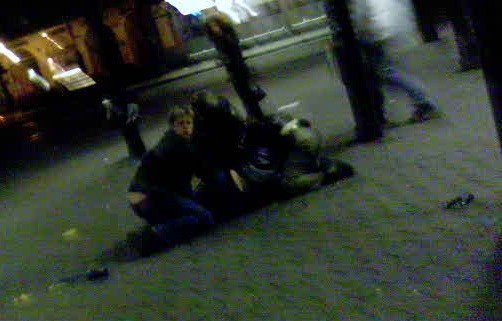
What I don't really get is this: See that guy with the blond hair looking at the camera? The one who's got his knee stuck in the drunk guy's kidneys? He wasn't a cop. He was just some other drunk guy. I'm not sure why the cops would let some random drunk guy join in on the police brutality here, seeing as that's sort of their job.
So, does that mean if I see someone getting arrested, I can run up and give him the elbow?
Man, the Dems haven't even been handed the keys to the executive toilets yet, and already people are declaring war on us.
That didn't take long.
Apparently, the bullshit detector is not standard equipment for Democrats:
Republicans are so afraid to run on their merits that they continue to resort to dirty tricks.
Listen to this robocall (.WAV) being sent to Virginia voters:
Tim Daly from Clarendon got a call saying that if he votes Tuesday, he will be arrested. A recording of his voicemail can be found online at: www.webbforsenate.com/media/phone_message.wav
The transcript from his voicemail reads:
"This message is for Timothy Daly. This is the Virginia Elections Commission. We've determined you are registered in New York to vote. Therefore, you will not be allowed to cast your vote on Tuesday. If you do show up, you will be charged criminally."
Daly has been registered to vote in Virginia since 1998, and he has voted for the last several cycles with no problem. He has filed a criminal complaint with the Commonwealth's attorney in Arlington.
I've been hearing these stories from the left ever since I started voting. The only voter intimidation I've ever personally witnessed is the same constant badgering of conservatives as racist, homophobic, reactionary, Christian fundamentalists that has become the mainstream criticism of the right in the media and, indeed, in general discourse. Now, I'm supposed to believe that the Republican party is creating personalized-yet-automated phone messages for Democrats in an attempt to illegally disenfranchise Daily Kos readers? While I'm for it in principle, I doubt they'd be that brazen.
What they're actually charging here is that Republicans are calling voters and threatening them with arrest if they vote Democrat. Now, I'm pretty jaded to the shrill whining that passes for Progressive political discussion, so I usually just scroll past such news stories as so much humbug. But what does that do for our general political alertness level? Who's actually going to notice if some sort of diabolically crooked electioneering really does subvert the American political process? I don't think that Diebold is really on the side of Republicans, guys. At least not to the point that they'd rat out a Democratic administration in y'all's favor.
The Democrats are going to get trounced in this election, at least if they get what they deserve. I'm so fed up with their mock outrage, I'm almost wishing I hadn't thrown my vote away on Libertarians. Get out there; vote Republican; and let's see if we can make that vein pop out on Kos's forehead again.
Technorati Tags: 2006 election, kos, politics, electioneering
- Novell NetWare vs. Windows NT (on the side of NetWare)
- Gravis Ultrasound vs. Sound Blaster Pro (on the side of Gravis)
- VESA Local Bus vs. PCI (on the side of VESA Local Bus)
- IDE vs. SCSI (on the side of SCSI)
- Atari 5200 vs. Colecovision (on the side of the Atari 5200)
In 1940, Gracie Allen ran for president as the Surprise Party candidate.
When I was up visiting the Straight White Guy last month, we discussed one thing that I'd always forgotten to talk about at blog meets: Blogging.
Eric puts out content more consistently than most bloggers, so I thought it would be interesting to know how goes about doing it. Unfortunately, he belongs to that shady Mu-Nu sect, so most of what he was saying came across as so much glassy-eyed Scientology to my untrained ears.
So, how does Rube 'post' a 'blog', you may ask? Well, let's take a look behind scenes!
[cue 'Leave it to Beaver' music and throaty-voiced announcer]
First off, Rube has to decide that he wants to post. This is actually the most difficult part of the entire process, and the weakest link in the chain of productivity.
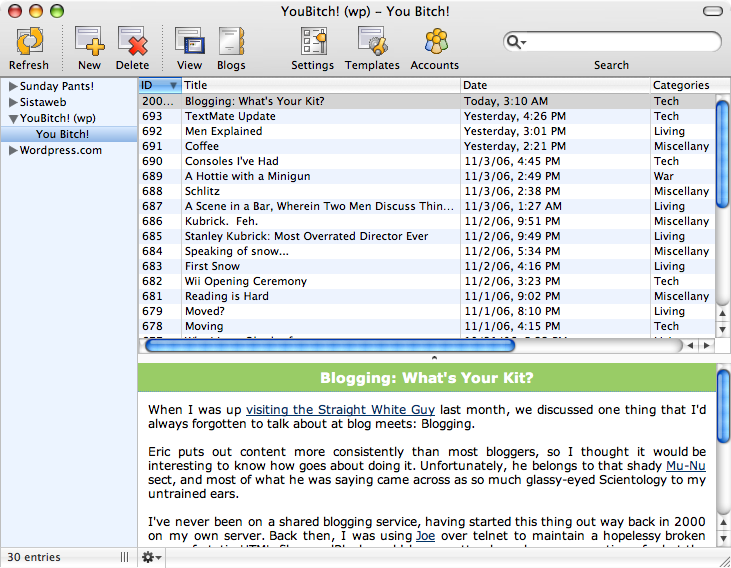
If Rube make it past that hurdle, Rube fires up his trusty blogging program, ecto (click pictures for bigger versions):
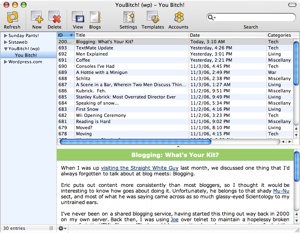
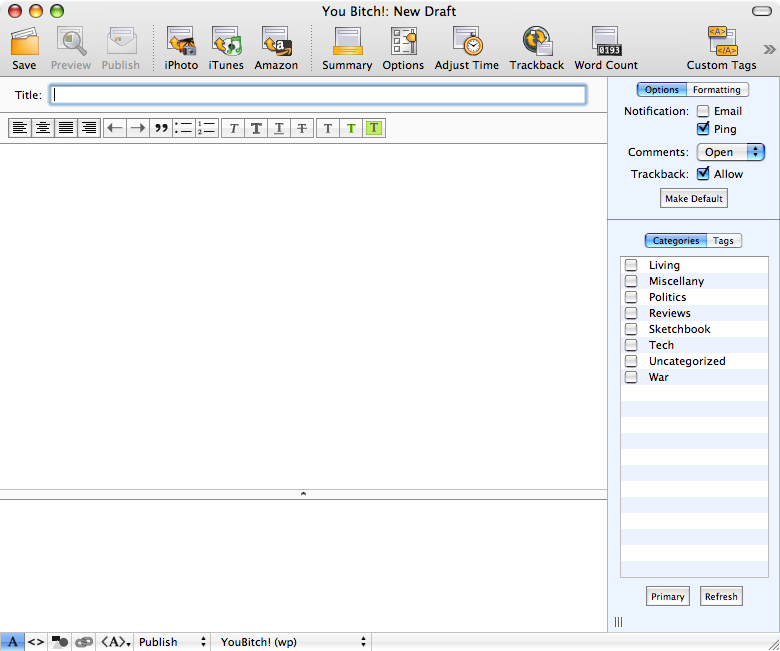
So, Rube clicks on 'New', and up comes the dreaded blank page of inspirationlessness.

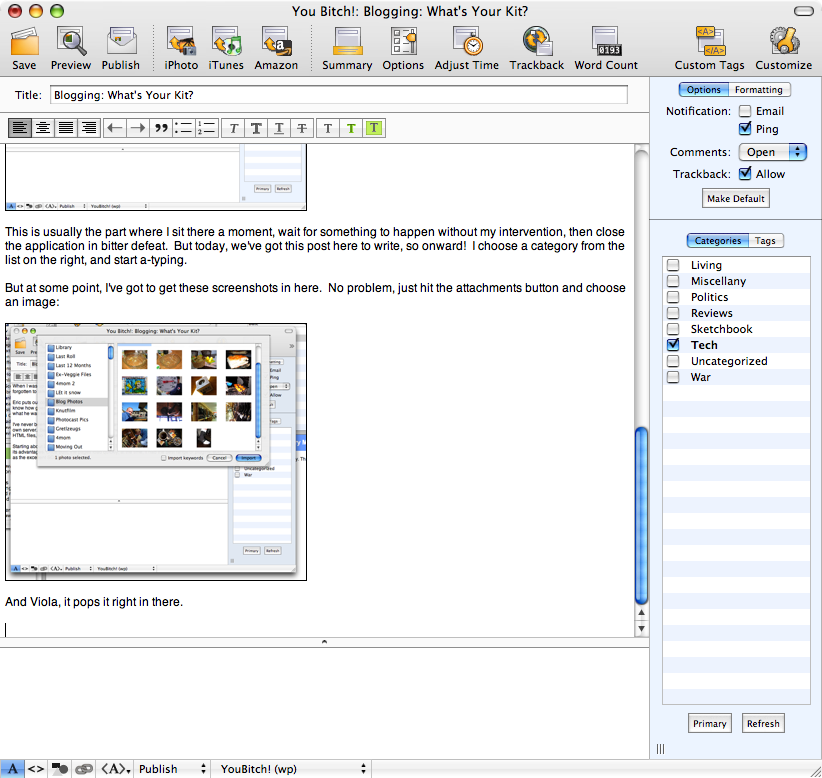
This is usually the part where I sit there a moment, wait for something to happen without my intervention, then close the application in bitter, crushing defeat. But today, we've got this post here to write, so onward! I choose a category from the list on the right, and start a-typing.
But at some point, I've got to get these screenshots in here. No problem, just hit the attachments button and choose an image:

And Viola, it pops it right in there.

Once I've gotten my (admittedly lackluster) post put together, I can either save it, with the vain hope that at some point in the future I'll actually try to improve it, or publish it without regard to quality, accuracy or entertainment value. So, I hit publish. At which point, ecto does the rest of the work, contacting the server, uploading the pictures, pinging Technorati, and God knows what tedious grunt work that needs to be done.
And that's how it gets done over here at YouBitch! So, what's your kit?
Technorati Tags: blogging, ecto, mac
Sam has some great pictures of Alaska up. Man, that place looks about as cold as where I live.
Technorati Tags: alaska, travel
Here's a minor update the BugMeNot Browser Button™. It's a little javascript-bookmarklet for your browser toolbar/favorites that will popup the BugMeNot Password for the page you're currently viewing.
BugMeNot
In Mozilla/Firefox, just drag it to your Favorites/Bookmarks toolbar. If you reach a registered-only news page, just click the button. In Internet Explorer (which you shouldn't use anyway), right-click the link and choose "Add to Favorites". Popup-blockers like Google Toolbar might interefere with its operation, unfortunately.
Still haven't found a way to make it pop up above the current browser window...
Technorati Tags: bugmenot, firefox
I opened up TextMate so's I could do me some programmin'. It updated itself to the latest version and reloaded, as it often does, and then it popped up the following release notes:
[2006-11-02: REVISION 1324]
[REMOVED] TextMate no longer pays tribute to human sacrifices, rape, nor does it show a picture of the God of the deaths in your dock -- ticket 945BEB5D
Which, you know, good thing, too. I was getting tired of all that rape stuff while I was trying to code.
Technorati Tags: rape, textmate
Sometimes, it's so simple to be a dude:
Like I said, once you start those male hormones flowing, you reduce what little brain the poor man has to something terribly, terribly primitive. That reptilian brain can't be bargained with, can't be reasoned with, feels no pity, or remorse, or fear, and absolutely will not stop, ever, until it has succeeded in injecting a healthy dose of genetic material into your poonanny.
If men were computers, they would have what's known as a Reduced Instruction Set. You save a lot of cycles that way.
Dear, sweet coffee. What would I do without you?
My crippling fear of the Wii, which I wrote about the other day, has led me to some nostalgic, wistful contemplations on my history as a video game-playing couch tater. I've been a bit out of the loop lately, as far as keeping up with the latest and greatest systems goes, but it seems like I've always had something around.
So here, for your amusement (actually my own), I've gathered together the This is Your Life lineup of the consoles that I've had.
1976 Sears Telegames Pong System
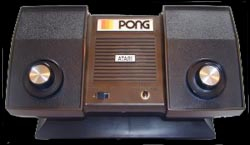
This may not be a picture of the exact system my dad brought home for Christmas in '76, but it's pretty darn close. The whole family had a high time with this little device. But I think it broke after about two months. Not bad, considering the vicious tempers that the men in my family tend to have; we break stuff when we lose.
Favorite Game: Pong.
Overall Impression: Revolutionary parlor-fun for any home!
1979: TI-99/4A Home Computer
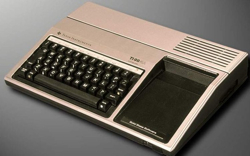
This was actually a home computer, and not a video game system. But the only 'computing' I did on it was typing in the craptacular games that came printed in Compute! magazine every month. Games were loaded using an audio cassette player and/or a plug-in cartridge. This system came to a sad, bitter end when I tripped over the cassette cable and ripped the motherboard clear out of the case.
Favorite Game: Tunnels of Doom!
Overall Impression: Nice keyboard. Pretty to look at. Crappy system.
1978: Atari Video Computer System
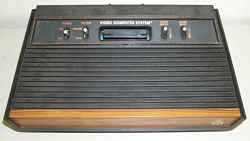
My first 'modern' console system, with plug-in cartridges, remote controllers, and all the other niceties we've come to take for granted. Also, the VCS (later 2600) was the only computer system I've ever owned with simulated wood grain panelling. This was also the first system that had a nemesis: The Mattel Intellivision. I reviled anyone who owned the Intellivison on principle, despite the lovable George Plimpton.
Once the system became obsolete, I inherited cartridges from everybody who'd ever had one. I still have about 200 games and a working system in my mom's attic.
Favorite Game: Yar's Revenge. Or River Raid. Or Warlords.
Overall Impression: Classic.
1982: Atari 5200
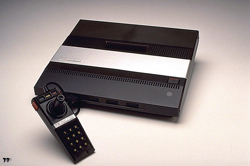
I still can't believe my parents bought this for me and my brother. It cost something like $200.00, way back in 1982, and the game prices were outrageous. Still, it's probably my favorite system I've owned, despite the risible controllers. This system was relatively rare compared its predecessor; it was practically unknown relative to the 2600. Nevertheless, a bitter hatred developed between owners of the 5200 and the Colecovision. Rich boys had Colecovision.
Favorite Game: Dreadnought Factor, one of the Best Games Ever. Or maybe Star Raiders.
Overall Impression: Awesome-looking box; best game selection at the time.
1983: Mattel Aquarius
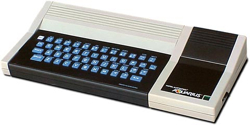
Another 'Home Computer' entry. Despite being released five years after the TI-99, the specs weren't any more impressive. I did actually learn to program BASIC on this computer; it also had a spreadsheet, called FinForm, and a word processor, called FileForm. Both of which sucked ass.
Favorite Game: Utopia.
Overall Impression: Crappy keyboard, crappy games. A better BASIC implementation than the TI, though.
1988: Nintendo Entertainment System
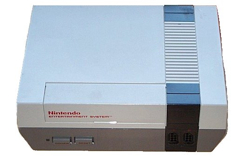
After five years, I had finally played my Atari 5200 to death. The automatic RF-switcher had stopped working, the controllers were all broken, and replacement parts were impossible to find. Heading off to college, I decided that I needed to drop 250 bucks on a video game system. Despite the fact that I blamed Nintendo for Atari's bad fortunes, I ponied up the cash for this little beauty, along with a light gun. I'm still completely baffled how the light gun worked.
This system, along with Super Mario Brothers, was 100% responsible for flunking my freshman year roommate out of Georgia Tech. Sorry 'bout that, Ernie.
Favorite Game: Super Mario Bros. Or Genghis Khan.
Overall Impression: Underpowered, less fun than the 5200, but not bad.
1992: Sega Genesis
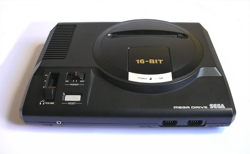
Once I got tired of waiting for a decent hockey game to come out for the NES, I finally decided to pick up something with a little more oomph. Since I worked at a toy store, I was confronted every day with the 16+-bit consoles that all the cool kids were buying. Turbografx, Super Nintendo, Jaguar. All of them were enticing, but my ex-girlfriend had had a Sega, so that was the deciding factor. I bought the Genesis, which came with Sonic the Hedgehog, and plunked down another 30 bucks on NHL Hockey '94. I never bought another game, even though I played just about every single day. I still can't figure out why NHL '94 never got old.
Favorite Game: NHL '94 or Sonic; that's all I ever bought. I can't stress enough that I played the crap out of these games. For years and years.
Overall Impression: First console I ever had with stereo sound. I'm not sure why I think that's awesome, but there you go. Awesome.
2006: Nintendo GameCube
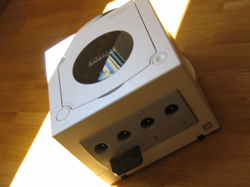
I can't believe I didn't buy a gaming unit for almost 14 years! I actually wanted to get an XBox, have it mod-chipped, and run it as a game console and a front end for my MythTV server. But that would've cost about 300 bucks, even without buying any games for it. The PlayStation 2 was also very seductive, but they're still chargin over $200 for it.
So, I dropped $70 on the less-capable, three-year-old GameCube, which came with the excellent, if weird, Mario Smash Football. The games are cheap, if you buy from Amazon, and some of them are excellent. Also, since people are upgrading to XBox 360s, you can get loads of cheap used games. That will probably just increase now that the Nintendo Fanbois are buying Wiis.
Favorite Game: SSX 3: Snowboarding without freezing your nards off. Metroid Prime kicks a little butt, too.
Overall Impression: A year or two past its prime, but a lot of fun on the cheap, as far as recent consoles go. Also, a great-looking piece of equipment. Unfortunately, the ol' console magic of the Genesis and the 5200 just isn't there.
So, what's next?
Maybe I'll get myself an XBox 360 at some point. I like the XBox Live concept, and there are some good-looking games out there. There's no way in Hell I'm dropping 600 bucks on a PlayStation 3, so it's the most logical choice.
Technorati Tags: atari, consoles, gaming, nintendo, sega

via Publius Pundit.
Technorati Tags: hottie, minigun
Schlitz is technically a lager beer. Schlitz is also the German word for "slot".
Hubert sat, looking thoughtful, twirling the wine in his glass. The pendulum had swung his way, and he was taking his time about answering the question posed.
"I see," he began, placing his wine on the table and artfully removing his spectacles. A handkerchief had appeared in his other hand, with which he slowly began polishing the half-moon lenses. "Well, I can forgive the thought behind that particular question. His genius can be difficult to see."
Roger was flabbergasted. "I'm sorry, did you just say, 'his genius can be difficult to see'?"
"Yes," answered Hubert, raising his eyebrows.
"Well," continued Roger, "I'm not exactly sure I understand what that means."
Hubert sighed heavily and placed his glasses back on the bridge of his nose. "It means, Kubrick's genius could be difficult for the– ", he hesitated. "For the casual observer to even notice, let alone truly understand." He took his glass in hand once more, and sat back in his chair, obviously pleased with his explanation.
Roger grabbed his beer glass, finding it sadly empty. He reflexively raised it in the air, swiveling his head looking for a waitress. Frustrated, he sat the glass back on the table and looked at his companion. "Why in heaven's name would genius, of all things, be difficult to see?"
Huber smiled and, slowly, as if addressing a child, said, "my dear boy, Kubrick's genius lies in the details of his actions, the subtleties, you understand. An uneducated observer could very well miss the meaning – indeed, the very existence of the nuances that separate him from inferior film directors." Check-mate, thought Hubert.
"For example?" Roger asked, one eyebrow raised.
Hubert sat deadly still. Even the wine lay dead in his glass. The bar seemed to have gone silent around them. Their eyes locked, the conversation became a Mexican standoff, each party afraid to blink. No, thought Hubert, feeling suddenly panicked. He's not afraid to blink.
Suddenly, an arm reached around Roger's shoulder, sat a full glass of beer on the table, and expertly whisked the empty glass away. Startled, Roger looked around, trying to see who it had been that had brought the beer. There were no waiters or waitresses to be seen.
Shrugging, Roger grabbed his glass and took a quick gulp. Pondering his glass, he said, "well, I call bullshit."
It was Hubert's turn to be flabbergasted. "But, how can you say that? Have you never seen 2001: A Space Odyssey? It's
genius!"
"It's a dud!" cried Roger. "What in the world is 'genius' about a bunch of men in gorilla suits dancing around a big black rock? It's the most asinine thing I've ever seen!"
Hubert cried out in terror. "Don't say that!"
But Roger continued. "It's three and a half hours of tripod shots! Didn't Mr. Boy Genius ever hear about tracks and dollies? About camera work! And what, exactly, did all those shots of astronauts jogging around in circles have to do with the central dramatic theme? That was half the movie, men in t-shirts jogging in place!"
Hubert gingerly sat his thin-stemmed glass on the table, despite the rage betrayed in his reddening face. "Kubrick was trying to convey the utter tedium involved in interplanetary flight, I'll have you know."
"'Utter tedium' is right, I'd say. That should have been the name of the movie! 2001: Utter Tedium. You know that part of the movie, where they're doing the interviews from Jupiter or Titan or wherever? The announcer says something like, 'the 8-minute delays between responses, caused by the distance between Earth and Jupiter, have been edited out for brevity'."
Hubert nodded, dreading what would surely come next.
"Well, I'm frankly amazed that Mr. Genius Director didn't leave those eight-minute delays in the movie."
Hubert straightened himself in his chair. "Ooooh, that's exactly the kind of cheap-shot I'd expect from a, a, casual observer like yourself!"
"Well," offered Roger, "just explain to me one thing. What's the compulsion that drives people to consider this obvious hack a genius?"
"Your question is flawed," countered Hubert. "There's nothing 'obvious' about Stanley Kubrick being a 'hack'."
Roger thought for a moment. "Well, you said yourself that his genius could be difficult to detect. Are you suggesting that he was trying to come across as a hack?"
Hubert sensed a possible opening though which he might escape. "2001 is an intellectual film about man's evolution as a sentient being, and his relationship with his creator, whoever or whatever that might prove to be. It's not Armageddon; I'm sorry that Bruce Willis was too young to be involved with the project. Perhaps if there'd been more explosions you would've found it more to your liking." With a dramatic motion, Hubert crossed his legs, crossed his arms, and raised his wine glass to his lips.
Roger took a sip of his beer, and kept the glass held below his chin. He frowned. "Okay, let's drop 2001, then. It's just a science fiction movie. That's no true measure of talent when it comes to directors. I mean, it's no Blade Runner."
Hubert exploded. "What is it with you, anyway? Stanley Kubrick is the most universally-respected director in the history of film, and 2001: A Space Odyssey is generally considered his magnum opus. Are you just being contrary?"
Roger slammed his glass on the table. "No, I'm just saying that it's a bit cold out for the Emperor to be walking around starkers!"
Hubert's eyes narrowed, the shaking of his hand sending ripples through the wine in his glass. "You wouldn't!"
"Oh, I would! If I have to hear one more time about how great the most boring science fiction movie of all time is, just because people are too afraid to say it's boring, boring!, I'll bring up Apocalypse Now! Don't push me!!"
Hubert's face had become purple. Not Apocalypse Now, he thought. The fatal blow. The Big One. If I have to defend Full Metal Jacket against that movie, I'm doomed! Suddenly, his expression changed. His features seemed to collapse in upon themselves. He appeared to have grown smaller, older, slumped in his chair. "Okay," he sighed heavily. "What do you want from me?"
Roger took a long swallow from his glass. He grinned, flush with victory. "I want you to tell me when you last sat through 2001: A Space Odyssey. In its entirety."
Hubert grew even smaller. "Oh, please. Not that..."
Roger's sadism knew no bounds. "Oh, yes. I want to know when, and I want to know where."
"Well," shrugged Hubert. "I bought the DVD."
"Have you unwrapped it?"
"Well..." Hubert's face developed a wrinkle, running from his mouth to his eyebrows. This became a crack, which became a trough, through which poured a river of tears. He broke down. Roger placed a gentle hand on Hubert's troubled brow, and lay his head on his own shoulder.
"There, there," Robert said.
Technorati Tags: 2001, kubrick
This Kubrick thing was really irritating me there...
Could somebody please tell me why, for the love o' God, everybody in the world has a hard-on for Stanley Kubrick? The WordPress theme you're looking at is named after him. I can't even read an Open Source Meganerd Article without getting a gushing ejaculative on who "the Best Director ever" was. Looky here, Poindexter: Stick to what you know and keep the tangents down to a minimum.
Let's take a look at Stanley's oeuvre, shall we? (courtesy of IMDB)
Eyes Wide Shut (1999)
Sucked. Legend has it, Kubrick wasn't director enough to coax good performances out of the two biggest stars in Hollywood, Nicole Kidman and Tom Cruise. A fitting end to an overrated, over-played career.
Full Metal Jacket (1987)
Sucked. The script is world-class, but the music, editing, and pacing of the movie (aka direction) were all off. The acting is also terrible.
The Shining (1980)
One of the only movies of Kubrick's that I actually like, and that's just because Jack Nicholson is a maniac. I mean, get a load of the music! And who the hell casted this movie? Shelly Duvall?! Talk about watching one man carry an entire production on his back, you can just see Nicholson rolling his eyes every time somebody besides him speaks.
Barry Lyndon (1975)
Never heard of it.
A Clockwork Orange (1971)
Another premium example of Kubrick's failure as a director. Terrible lighting, terrible acting (except for the always-excellent Aubrey Morris as Mr. Deltoid), horrifyingly bad art direction, lousy special effects, and the abject dumbing-down of an awesome story by Anthony Burgess. It shows how Kubrick never could keep his actors in line when a B-list palooka like Malcolm McDowell could walk all over him like he did in this overrated sleazefest.
2001: A Space Odyssey (1968)
Ugh. Gack! The movie that epitomizes the lemming-like fascination people have with Kubrick. This is one of three movies I've walked out of after paying money to see it; the other two were Kill Bill vol. 1, and Chariots of Fire. Boringest, longest, most overwrought pile of self-important static camera shots ever produced. The only good thing about this movie is that it inspired the opening scene to History of the World, Pt. 1.
Dr. Strangelove or: How I Learned to Stop Worrying and Love the Bomb (1964)
This is a funny movie, but only because of Peter Sellers. George C. Scott got so absolutely fucked by Kubrick that he died hating the man, almost 40 years later. In the DVD version, it's explained that Scott's performance was so blatantly over-the-top (just watch the "Blast-off!" scene near the beginning) because of Kubrick: He shot each of Scott's scenes three times, one comical, one subdued, and one so ridiculously overdone that it could never be put into the movie. At least, that's how it was explained to the actor. During editing, Kubrick decided to put in only the overacted takes. It almost ruined Scott's career, which was a lot more impressive than Mr. Best Director Ever's.
Lolita (1962)
Yawn. How do you make a boring movie out of a hot young teenage girl crushing on a frustrated, vulnerable older man? Why, just ask Mr. Best Director Ever!
Spartacus (1960)
Typical late 50s gladiator movie. Memorable only for the fact that Kirk Douglas is the biggest badass of all time.
Paths of Glory (1957)
It's OK. Kirk Douglas is the usual badass. If you want to see this movie done well, check out the Tales From the Crypt episode Yellow. Basically the same story, also starring Douglas, but with better directing by hack horror goon Robert Zemeckis.
Kubrick was an egotistical journeyman director who coasted to fame on the backs of Kirk Douglas and Peter Sellers; two actors who even Mr. Best Director Ever couldn't dominate into acting like high school drama fags. He was just another overrated blowhard, with one or two halfway-decent movies and an army of posers trying to make a god out of him, to the greater glory of mediocre artist-wannabes everywhere.
You want to know who the actual best director ever was? Here's a list of people whose jocks Kubrick wouldn't be director enough to carry, take your pick:
The Coen Brothers, Alfred Hitchcock, Ridley Scott, Francis Ford Coppola, David Fincher, John Huston. That's what a good director looks like.
Technorati Tags: 2001, kubrick, a clockwork orange