
Schlafmnzen
Posted by Rube | 2 November, 2003
I know it's not a thing that's particular to Europe, but there's just so much of the inneffectual, bureaucratic shit floating around at the moment.
At the moment? It's really been going on for years, now. I'm not sure if we've ever discussed this, but for the last 10 years or so, there's been a movement among the Germans called the "Neue Rechtschreibung", which basically translates to "The New Way to Write Correctly". Un-be-lievable what kind of energy went into this. They've basically effected changes in all the goofy, idiosyncratic areas of the German language. They've split up some of the longer words (and there are some damn long words) into their component parts, they've marginalized some of the special characters like , , and . Basically, what they've done is taken the language and cleaned up some of the messy legacy weirdness. Ok, it sounds good on paper. For about a second. That meant, of course, that everybody had to re-learn how to write and say many things. They also had to buy the new, updated dictionaries and grammar guides. There's the attendant infrastructure involved in getting 'the word' out, of course. All handed down from on-high by the Big Thinkers of the universites in Berlin, Cologne, and Aachen.
But nobody likes it. And why would this happen, anyway? Who really benefits from the simplification of the language? And who really has the power to decide how people should speak, read, or write? I talked a spell with a friend of mine about all this. She's finishing up her master's degree at the moment, and is therefore digging knuckle-deep in the nose of academia, whence this whole horseshit came. I've never been much of a populist, but the slumbering american frontiersman in me can't even grasp the chutzpah people show when they hand down edicts like this. Languages evolve over centuries, and the inefficient parts die quietly or survive due to their other qualities; aesthetic, humorous, or otherwise. She is more of a typical german from the hinterlands of Bavaria, and usually stares blankly at the university turtlenecks who try to explain how all this is good for "das Volk".
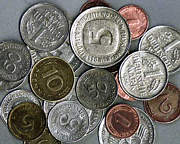
And that brings us to the Euro. It's no different from the Neue Rechtschreibung in my book. It was just something they decided on one day in a glass palace somewhere, and really never took a vote on it. The few countries that relied on referenda to decide whether or not to get their Euro on have all voted no; see Sweden and Great Britain. I read an article in Der Spiegel today that blew my thick, white, cottony, american socks off. The headline was, "Germans are Sitting on D-Mark Coins worth over 3.8 Billion Euros", in reference to the billions of coins people still have in jelly jars, old jackets, and automobile ash-trays. Coins that are now worthless. Personally, I have at least 20 or 30 bucks worth of coins and bills that turned up during the first year of the Euro, and I've only been here a few years. I can't even imagine what my coin-collection would look like if I'd been here my whole life.
So, the article goes on to say that this delinquent coinage represents about half the coins that were in circulation when the Euro went into effect. Half...the...coins. I have absolutely no idea how much of a nation's economy is represented by the coins in circulation. It may be absolutely trivial in contrast to the wealth collected in bank accounts, credit cards, and folding money. But still, that's about 4 Billion dollars that were simply invented by burdening the people of Germany with a currency reformat. Germany may have the second-largest economy in Europe, but it has the most fastidious population, as well as the most miserly. I can't even imagine how much money went missing in the other, more loosy-goosy Euristans. I guess it's one way to revalue your currency: declare a big chunk of it as invalid.
But what the hell am I going on about?